The Carousel of Plenty
The season's real subject turned out to be the good life — and the kind of luxury that comes from a better place than scarcity.

This is the end of the Carousel of Plenty series, and the 52nd consecutive weekly Circudyne Letter. One letter a week, every week for a year. Worth a moment of reflection.
There seem to be as many ways of running this kind of enterprise as there are entrepreneurial writers. The goal of presenting circularity transformation as something more than a sustainability play — that it's the next form of progress, that it is Lean's successor, that it pays, that the culture is already turning toward it — has pulled me in several directions. My instinct at the outset, which I think has been validated, is that collecting essays into series would provide discipline and creative constraint. Each of these four seasons has felt as much like a semester at school as a quarterly deliverable. It's been a joy, and educational.
Carousel of Plenty is more than an abstraction. Like the Circular Century, it's a place to go. A destination you cannot picture is a destination you cannot want. So this season we went and furnished the place. Patterned on a great medium from the last century: The GE Carousel of Progress.
Like its predecessor, this carousel ride runs through aspirational wonders, like the Robot Milkman, the home that improves with age, a tailored and timeless wardrobe, and a cheap place to eat that's built like a temple. I expected, setting out, that the season would be a catalog. It turned into an argument about the good life.
Luxury decouples from scarcity
Luxury is the business of aspiration. Aspiration is easy to stimulate when there is a competition for goods, and the whole machinery of marketing runs on staging that competition. But the competition changes character depending on where you stand on Maslow's pyramid. Down at the base it is existential. "If I don't get that loaf of bread" is a sentence about survival. Near the top it is a proxy fight. "If I don't get that sports car" is a sentence about standing. The two could not be more different in substance. The feeling underneath them is identical: I have to have it.
That feeling is the marketer's product. Scarcity enables it, and the linear economy learned how to make it out of nothing. Manufactured dependence takes several forms. It embodies things like planned obsolescence, which we have all learned to disdain but have not yet systemically resolved, or evolved to resist.
That changes in the Circular Century. Three forces press new forms of abundance into everyone's hands. When you make your own power, when intelligence is wired into everything like electricity, when nothing is wasted and stuff is conserved into the form of equal or better stuff, the hustle loses its cultural and psychological grip. The competition slips ever higher up Maslow's pyramid, until one day the only things left to argue over are art and philosophy.
The idea of that world turned out to be the center of gravity in this season. When abundance is real and beauty is everywhere, rarity can no longer be the thing that makes something luxurious. The discriminator moves to joy, to craft, to fit, to meaning. Offered caviar or cherries with the scarcity premium stripped away, a person might honestly choose the fruit, because what they want is the thing that fits their life, not what impresses the neighbors.
Aristocratic bearing for the rest of us
We dwelled for a time on aristocratic bearing. In today's context, that connotes snobbery. But bearing is not snobbery. Bearing is comfort with one's place in the world. It is the posture of a person for whom the question of material survival is settled and stays so. Despite living in a far more prosperous age, today few people ever feel it; just when somebody makes it, the race for more just restarts. Substantial wealth is not the same as enough. The treadmill does not care how fast you are already running.
To the luxury trade, and in the good life as it has been sold to us, "enough" is a word that is seldom uttered. General Electric, the sponsor of the Carousel of Progress, used to say: we bring good things to life. That was progress: the good life is more things. A hundred or so years ago, that is what we needed to hear. Today, it's the sound of the century we are leaving. And it is the precise opposite of what the Circular Century offers, which is enough — the right amount, kept, maintained, yours. It is aristocratic bearing for the rest of us.
Which raises the question. If aspiration is the raw material of the good life, is there anything left to long for where "luxuries" are common? There is, and this is the point. When beautiful objects are everywhere, owning what's scarce is no longer the source of pleasure. That is the noblesse — the nobility that comes from the pursuit of higher goals than the hustle.
Noblesse is the "so what" of joy. It is the working knowledge that you own your joy in the material world, that it cannot be rendered obsolete by the next product cycle. Quality was the dividend of Lean. Circularity turns that value into a Quality Cascade, at the end of which sits a kind of dignity that can reach not only every person but, because the waste has been designed out of how we make things, every living thing.
Circularity is the decoupling of value from extraction. The good life in the Circular Century is a similar decoupling: the good life unhooked from the economic and environmental hustle that has always been its price.
A carousel that moved in a straight line
The General Electric Carousel of Progress opened at the 1964 World's Fair and runs to this day at Walt Disney World, an Audio-Animatronic family man narrating the march of household progress across the decades, all of it resolving into the Sherman Brothers song There's a Great Big Beautiful Tomorrow. We encounter it today as nostalgia. Read it the way Marshall McLuhan taught us to read things, and it becomes something more peculiar.
Look at the medium, not the appliances. The audience sat still while the theater revolved around fixed stages. Progress was a thing that happened to you, automatically, while you were carried past it in a comfortable chair. The past stayed put as a diorama you left behind. Tomorrow stayed permanently one act ahead, never arriving, because the show had to loop and the buying had to continue. The medium was a circle. The message was a straight line that never reached its end. A story about a treadmill. Beneath the warm family scene, the good life was something you consumed.
The Carousel of Plenty keeps the metaphor and fixes the message. This time the content is finally as circular as the form. Tomorrow stops receding, because the season's promise is not more but enough, and enough is a place you can actually step off the treadmill.
The season at a glance
The Carousel of Plenty was conceived as a catalog, and it reads best as one. Twelve scenes, each depicting something the Circular Century makes ordinary, arranged from the infrastructure outward to the self and its freedoms.
The Robot Milkman
The delivery that arrives full and leaves with the empties.
The season opened on the humblest possible image, a little robot that delivers goods and picks up the empties. It symbolizes the larger machine: a business that profits from the return trip, not the replacement sale.
→ When the maker is paid to take it back, abundance and waste finally stop traveling together.
The Atelier
The workshop that keeps alive what you already own.
The institutional form behind the season. Not a store that sells you the next thing, but a house that maintains, alters, and renews the things you have, the way the wealthy have always kept a tailor.
→ The atelier of democracy: the artisan's relationship with objects, available to everyone.
The Neighbors
Production moves back onto the street.
Distributed making, local energy, the productive neighborhood. The supply chain shortens until it runs down your own block.
→ Sovereignty is partly a matter of distance. The shorter the line, the freer the household.
The Living Home
How it feels to live in a home that gets better with time.
The dwelling as the test case for everything. A house that appreciates through care rather than depreciating through neglect.
→ Maintenance is not a chore you owe the house. It is the house returning the favor.
Energy Sovereignty
The house that powers itself, and the grid that thanks it for it.
The three Dynamos made domestic. Distributed power, storage, and intelligence turn the home from a meter into a small, generous utility.
→ The clearest taste of bearing the season offers: a household that owes the system nothing it cannot supply itself.
The Companion Device
The device fitted to you on your first day of school, still yours a lifetime later.
The anti-upgrade. A device that ages like a baseball glove, grows with you and earns its character through the long collaboration between maker, owner, and time.
→ Systemic Beauty over the spec sheet. The object becomes a record of a life rather than a reject in a landfill.
Something Borrowed
Owning, borrowing, pooling: three modes of access, three new freedoms.
The performance economy comes home. You buy the outcome, not the hardware, and the maker stays on the hook for the whole life of the thing.
→ Access unbundled from ownership is access unbundled from burden.
The Curated Wardrobe
Your style — not the season's, not the algorithm's — fitted, refreshed, expertly maintained.
The closet as studio. Clothing chosen for fit and meaning, kept in good order, free of the churn that fashion manufactures.
→ The morning starts settled. The settledness is the luxury.
The Commissary
The good meal, made near you, served like a civic right.
The automat reimagined as a temple of democracy: everyday craft and local food offered with a dignity usually reserved for the costly.
→ Plenty is not a private hoard. At its best it is a shared room.
Personal Mobility
The right vehicle for every trip, owned by no one in particular.
Mobility unbundled from the car in the driveway. Here the season named its own terms: conspicuous consumption giving way to inconspicuous craft, and the Sufficiency Frame arriving as a stated idea.
→ The freedom is not the second car. It is no longer needing it.
Coping with Abundance
What people do once the struggle for enough is finally over.
The turn from catalog to sociology. How earlier breakaways from scarcity — the old aristocracy, the digital generation — handled their abundance, and what the Circular Century can learn from both.
→ Abundance is not the end of the story. How a culture carries it is.
The Circular Century — So What
The last letter asks what all of it is for.
The finale convened a council of the departed and put one plain question to the season: so what? The answer: nothing less than the evolution of humanity into something we can be proud of.
→ Sovereignty, joy, and worth, folded into one. The telos the furniture was always serving.
What it was all for
Read forward, the season is a showroom. Read backward from the finale, it was never about the robot or the wardrobe. The objects were means. The end was the bearing they produce: a life in which your joy is your own, the material question stays settled, and the dignity of enough extends, for once, to the rest of the living world as well as to you. That is the noblesse the Dynamos make possible, and it is the closest thing to a moral the season has.
The seat we left empty
Every pavilion at a World's Fair had a sponsor. Progressland had General Electric, and the arrangement was honest: the sponsor's products were the content. Progress meant appliances, and GE made appliances.
So who sponsors the Carousel of Plenty? By the same logic, it should be the firm whose product is the Circular Century's furnishings — the one the finale called the Toyota of Circularity, the company that proves circularity like Toyota proved Lean. The trouble is that this firm does not exist yet. And it cannot be a company built in GE's image, because GE's whole ethos was more, forever, and the Circular Century's promise is enough. The right sponsor is whoever first figures out how to build a great business out of sufficiency, which sounds, in the old grammar, like a contradiction.
So we have left the seat empty on purpose. The Carousel of Plenty is, among other things, a casting call. It describes the pavilion in enough detail that the right tenant should recognize the address.
🔎 Coming up next season: an answer to the casting call.
Parting thought
When the season began, the Circular Century was an idea. By the end it was an address, with a robot and a kitchen and a home that ages well. But the thing worth betting on is not these furnishings. It is the decoupling underneath them — the good life finally separated from the hustle that always used to be its rent. The linear economy promised progress and delivered volume. The circular economy promises enough, and delivers plenty: the precise amount that satisfies without burdening, and the bearing that comes with knowing it will stay.
📬 Thank you for reading this season of The Circudyne Letter.
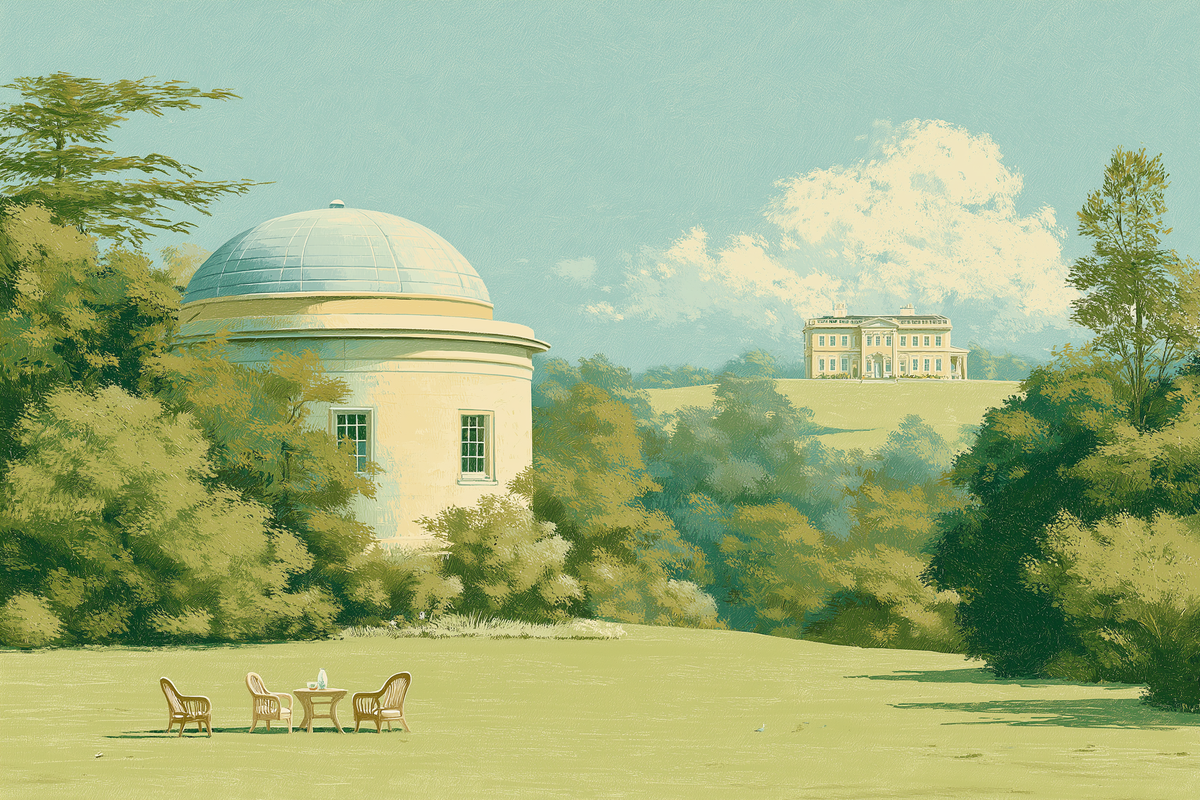
Image prompt: A large circular mid-century-modern theater on a sunlit Edwardian country-house lawn - a graceful domed rotunda, taller than the trees around it but settled into the landscape, its curved wall and low segmented dome rising just above a surrounding grove, large enough to dwarf the small empty wicker chairs and tea table on the grass in the foreground, a grand manor house on a rise in the middle distance, deep generous lawn, eye-level view, calm and quiet and faintly uncanny, muted gouache painting, soft painterly flat color, restrained warm palette with silver-teal accents, Rod Serling stillness, no people