The Personal Companion
A device fitted to you on your first day of school, that grows with you across a lifetime. What consumer electronics looks like when it lasts.

This letter is part of the Carousel of Plenty, a series exploring products and services that could only exist in the Circular Century. We talk a lot about circular transformation — why it matters, how it works, what it demands of leaders. This season, we show you where it leads. Each essay presents one solution: something you'd use, live with, or depend on in a world designed for permanence rather than disposal. The premise is simple. The linear economy promised progress and delivered volume — more things, fewer of them worth having. The Circular Century delivers plenty: the precise amount that satisfies without burdening. These are its furnishings.
A Friend You Never Have to Say Goodbye To
Now then. Pull up a chair. Sit a minute. I want to tell you about the day my granddaughter started school.
She picked the fabric herself. Blue with delicate flecks of gold. We brought it down to the atelier on Saturday and the artisan fitted the case to her hand — to her hand, not the size on the chart. Hers. He said she'd grow into it but he wanted to be sure it fit her right today, on the first day, when it mattered.
Now folks, this is the part I love. That little device knows her voice already. Knows the way she draws. Knows she likes her stories read slowly and her songs a little silly.
She's gonna have that same Companion when she goes off to college. Same one when she gets her first job. Same one when she's holding her own grandchild, and that grandchild reaches up and the Companion knows that little hand too.
The chassis on my own Companion is a sturdy old thing. The skin's been changed three times. Modules upgraded — well, who can count? Software's never the same software for two months running. But the thing — the thing I carry, the thing that knows me — that's the same thing. It's like an old friend.
A friend you never have to say goodbye to.
That's plenty, friends.
For the Consumer
Do you have a baseball glove? Then you know there is a particular sound a baseball glove makes late in its life. The leather has darkened in the pocket. The lacing has been replaced twice. The webbing carries the scars of a full life. You might say that Rawlings made the glove, but you made it your glove. It's a peculiar partnership, but not complicated. Ask any catcher whose name belongs on their glove and they'll tell you: both of ours.
This is the relationship a Companion Device proposes. Not a phone you replace every two years, or a watch you trade in after three. A thing fitted to your hand, your voice, your life, that gets better the more you hold it.
We have been told, for as long as most of us have been buying consumer electronics, that this is impossible — that the price of progress is disposability, that you cannot have both the relentlessly improving silicon and the lifelong companion. The linear economy forced us to choose. The chip's lifespan became the object's. When the chip aged out, so did the object. At which time the poor thing went into a drawer, and from the drawer to a landfill, and you went and bought another one, and the relationship that might have grown was canceled before it could begin.
Joy is the opportunity cost of that arrangement. The spark of joy is the signal that long-arc utility is being maximized — the sign that an object has earned its place in your life across enough of your life for the bond to mean something. Disposability is not just wasteful. It is the compulsory absence of the conditions under which attachment becomes possible. The linear economy did not merely throw things away. It threw away the possibility of attachment.
A violin
Consider a 250-year-old violin. The luthier who made it is long gone, but the instrument has been played by a dozen virtuosi since. Each performer left something in the wood — the way a particular bow stroke wore a faint groove, the way the body resonated to a particular range of vibrato, the slow chemistry of varnish and air and rosin. When Anne-Sophie Mutter draws the bow across her violin, she is not playing alone. She is playing in collaboration with everyone who played the instrument before her, and with the maker who chose the wood, and with the time that taught the wood to sing.
The character that violin has accumulated is what makes it capable of expression in the first place. Not despite age. Because of it.
This kind of virtue has historically been accessible only to people who could afford instruments worthy of earning it. Stradivarius for the soloist. Patek Philippe for the collector. Hermès for the heir. The rest of us got things on a two-year clock, and our objects never lived long enough to mean anything.
The Companion Device is the access-for-all version of that virtue. Not every Companion will become a Stradivarius. But every Companion is the kind of object whose accumulated character is real, legible, and inheritable. It's beyond the realm of a feature: a person's Companion will conform to their life in a way no spec sheet could capture. It forms a substrate of the life it accompanies.
Pace layers
Stewart Brand taught us that complex things are made of layers that move at different speeds. Fashion moves the fastest — experimental, volatile, gone next year. Commerce moves more slowly. Infrastructure slower still. Governance, slower again. Culture over generations. Nature, slowest of all. A healthy system lets each layer keep its own pace without dragging on the others.
To understand pace layers is to understand why, despite their miraculousness, consumer electronics objects have become so fraught and joyless. The silicon is fast. The chassis is slow. The relationship is slower still. Linear economics welded them all to the timeline of the shortest-lived components, which meant the slow layers were destroyed every time the fast layer turned over. Imagine throwing away your house every time you replaced a light bulb.
The Companion Device is designed to separate the layers again. Software moves continuously. Modules turn over in months. The skin gets refreshed at the atelier every few years. The chassis lasts decades. The patina accumulates across the whole life of the object. The soul — the relationship between the device and you — is the slowest layer of all, and the one that matters most.
Because the pace of progress is fast and linear economics demand disposability, we are deprived of the joys of good old things. The best of both worlds is when there is balance between progress and continuity. The new doesn't prevail by default; it has to compete against the tried and true. The Circular Century is the first economic order that lets old and new compete on the merits, and combine delightfully.
Maintenance is the medium of caring
Brand recently wrote that owning a horse means tending the stall, the paddock, the hay, the tack. A form of caring, he called it, a relationship with another sentience. The horse can care back. He wondered, in the same chapter, whether something like that might come again someday — a vehicle that cares back.
A relationship with another sentience requires work. That sentience is what is capable of caring back. We need to accept the former if we are to enjoy the latter.
Brand again: when you take responsibility for something, you enter into a contract to take care of it. If it's a child, to keep it fed. If it's a knife, to keep it sharp.
The linear economy stripped maintenance out of consumer life and called it liberation. Don't worry about it; just buy a new one. What was actually being stripped out was the only loop through which an object could earn its place in your life. The horse could care back because the contract of care made the relationship real. Sever the contract and the horse becomes a unit of transportation. Severed enough times, you forget that vehicles ever cared back at all.
The Companion Device cares back. Not necessarily because it's sentient — though it might be, in some defensible sense, by the time the technology matures — but because the system has been redesigned to permit the kind of relationship a horse used to be capable of. You take it to the atelier. You choose the new skin. The technician shows you the wear pattern on the case and asks how it happened. She remembers your last visit. The Companion remembers everything. The relationship is real because the system permits it to be real.
Aristocratic living without the aristocracy
Horace Dediu poses the question in a way that captures the essence of humane progress: look at what rich people do today, and ask how that gets done for the masses tomorrow. Rich people don't price-shop flights. They don't decide between driving and Uber. An assistant handles it. Then the phone became the assistant. The pattern of history is consistent: aristocratic privilege graduates into ambient capability. The average person today lives better in most material respects than a king did 200 years ago.
The move the Companion Device represents is not that Patek Philippe condescends to the mass market. It is that Apple's offering comes to resemble Patek's — because economic and technological advancement, properly directed, bring durability, service relationship, and provenance within reach for the rest of us.
Today's level of progress might let us live like aristocrats without living under the reductive geometry of the aristocracy. That is an open possibility, and a continuing trend. The aristocrat's freedom required a constrained class beneath him; the Companion Device's owner is free without constraining anyone.
The broad answer to Dediu's question transcends luxury. The aspiration ought to include the absence of financial fear for the future, and the presence of available alternative pursuits for everyone. Modern abundance as we have defined it (Distributed Power, Ambient Intelligence, and Recombinant Matter) severs the relationship between the scarce and the aspirational.
The linear economy taught us a false dichotomy. Everything good-and-accessible was new and disposable (the iPhone). Everything good-and-aspirational was old and long-lived (the Patek). That split is not a law of nature. It is the visible signature of a single economic regime nearing its end. The linear economy is finishing where it had to finish — wasteful and enshittified. Its successor, if this generation meets its moment, collapses the dichotomy.
The third element of Systemic Beauty
A first swing has been taken. The approach Fairphone has taken is directionally correct: a phone designed to be repaired, with parts you can replace yourself. Honor where honor is due.
But Fairphone employs modularity the way Dell does — user-upgradable, and little else. That misses two of the three elements of Systemic Beauty:
Compositional Logic — a unified design grammar across the parts, so the object reads as one thing even as the parts age at different rates.
Instructional Design — the composability is self-evident; the system teaches you how to use it without manuals or specialists.
LEGO is the canonical case. Modular, yes — but beautiful because the modularity is governed by a unified compositional logic, with instructional design baked into the bricks themselves. IKEA, at its best, achieves the same combination.
The Companion Device adds a third element to Systemic Beauty that LEGO and IKEA haven't quite reached: timelessness. Old elements that provide continuity. New elements that enhance capability. Combined and synergized in a single object that does not date.
If we find the combination improbable, or vaguely alarming, it is only because we have lived exclusively under a linear-economy regime. Product design, business design, strategy, and ultimately politics will all be liberated by moving onto what comes next.
That is the consumer's experience. Now we have to look at how the producer makes it possible.
By the Producer
The Companion Device rests on a single strategic claim that turns the consumer-electronics business model inside out.
The chassis is not the product. The relationship is the product. The chassis is just where the relationship lives.
Every traditional consumer-electronics firm sells the chassis. The annual keynote. A new model. The same unit-sales economics. Customer-relationship management is something that supports the unit sale. The Companion Device firm reverses the polarity: every unit sale is a moment that supports the relationship. The chassis is durable infrastructure. The relationship is what the firm actually sells.
Pace-layered architecture
Borrowing Brand's frame and applying it to the object:
| Layer | Pace | Authored by |
|---|---|---|
| Soul | A lifetime | The owner |
| Patina | Years | Time + use |
| Skin | Years | The atelier |
| Modules | Months | The manufacturer |
| Software | Continuous | The manufacturer |
| Chassis | Decades | The manufacturer |
The chassis is slow. The silicon inside it is fast. The object survives the upgrades because the upgrades aren't the object. This solves the apparent paradox we keep being told is unsolvable: the device is both relentlessly improving technology and the lifelong companion. They live on different layers. Like the ship of Theseus.
The same architecture has existed for decades for capital products. The table above just as well describes a long-lived airliner: chassis is the airframe; modules are engines, avionics, interiors; software is fleet-wide updates; skin is livery; patina is hours flown, the airworthiness directives serviced over decades, the registry the airframe carries; soul is the operator's brand, the routes flown, the passengers whose lives it has crossed. The Companion Device is what happens when this familiar capital-product discipline is brought to a consumer product whose previous form was a two-year disposable. The discipline already exists for the things that had to last; the Circular Century extends it to the things that should last.
Strategy Choice Cascade
Winning Aspiration. Be the maker of the artifact that can accompany your customer for their entire life.
Where to Play. The thresholds. First day of school. First job. The wedding. The new child. The Companion enters life at thresholds, because thresholds are when people are most ready to commit to a long relationship.
How to Win. A chassis built to last. A module ecosystem that upgrades it at the appropriate pace. An atelier network (the Atelier) that personalizes it. A return logistics layer (the Robot Milkman) that closes every loop. Software that learns the owner across a lifetime.
Must-Have Capabilities. All three elements of Systemic Beauty designed in from day one:
- Compositional Logic — a unified design grammar across chassis, modules, software, and skin, so every layer reads as part of one object even as the layers age at different rates.
- Instructional Design — the composability is self-evident; the device teaches its owner how it can grow with them, without manuals or specialists.
- Timelessness — old elements that provide continuity, new elements that enhance capability, combined and synergized in a single object that does not date.
The system layers underneath: Recombinant Matter at modules. Ambient Intelligence at software. The Robot Milkman for logistics. The Atelier for Skin.
Enabling Management Systems. Churn becomes a failure mode, not a KPI to manage. Years-of-relationship becomes the leading indicator. The chassis appreciates as long as the relationship continues. The accountant finally has to learn what the watchmaker has known for two centuries: a thing that lasts is worth more, not less, every year you keep it.
For the model to work, all of the following must be true at the same time:
The manufacturer has to stop fearing retention as a constraint on new sales and treat it as the only thing the firm is actually selling. Customer relationship is not a sales event. It is the entire enterprise.
The atelier evolves with the owner. Hot-rod-shop and tattoo-parlor at twenty. Haute materials and quieter modifications at forty. The same chassis underneath. The same relationship deepening.
Why we call this season the Carousel of Plenty
This is the right essay to step out of the frame and tell you why we named the season what we did. There are two carousels that remind us of what the Circular Century resolves.
Carousel one is GE's Carousel of Progress — the 1964 World's Fair pavilion where a family man advocated for his household's experience of progress, scene by scene, decade by decade. The Madison Avenue voice that the Pitch sections of these letters borrow. Now then, friends, pull up a chair. Progress as something the family lives through and is bettered by. The forward pull.
Carousel two is Don Draper's pitch in the Mad Men episode "The Wheel," written by Matthew Weiner. Draper, pitching a brand identity for the Kodak slide projector, walks through old family photographs and reframes the device. Technology, he tells the room, is a glittering lure — but on rare occasions a product earns a sentimental bond with its user. He cites the Greek root of nostalgia: the pain from an old wound. The slide projector, in his telling, is not a spaceship; it is a time machine. It travels round and back, the way a child travels, to a place where we know we are loved.
The two carousels point at the same dynamic: humans are pulled by both the new and the old. The linear economy could only sell us the new — by definition, because it had to dispose of the old to repeat the sale. The result was a culture starved of the second pull, with the first pull turned up to manic. The Circular Century restores the second pull. The Companion Device is the artifact through which the restoration is most visibly felt.
This is the source of marketing power that lies dormant in business models that make products designed for discard. Nostalgia, as Draper's pitch names it, is the emotional substrate the linear economy systematically prevented its products from earning. Circular business models don't merely permit nostalgic bond — they generate it, as a structural by-product of the relationship lasting long enough to produce it. That is a marketing capacity unavailable to incumbents whose business model precludes the relationship from getting "old enough to ache for."
The Circular Century is the era in which we get to have both pulls at once. It provides a vocabulary and coherent forward-looking mythology in which progress and nostalgia are no longer at war.
That is the brand promise. The Companion Device is the artifact that delivers it.
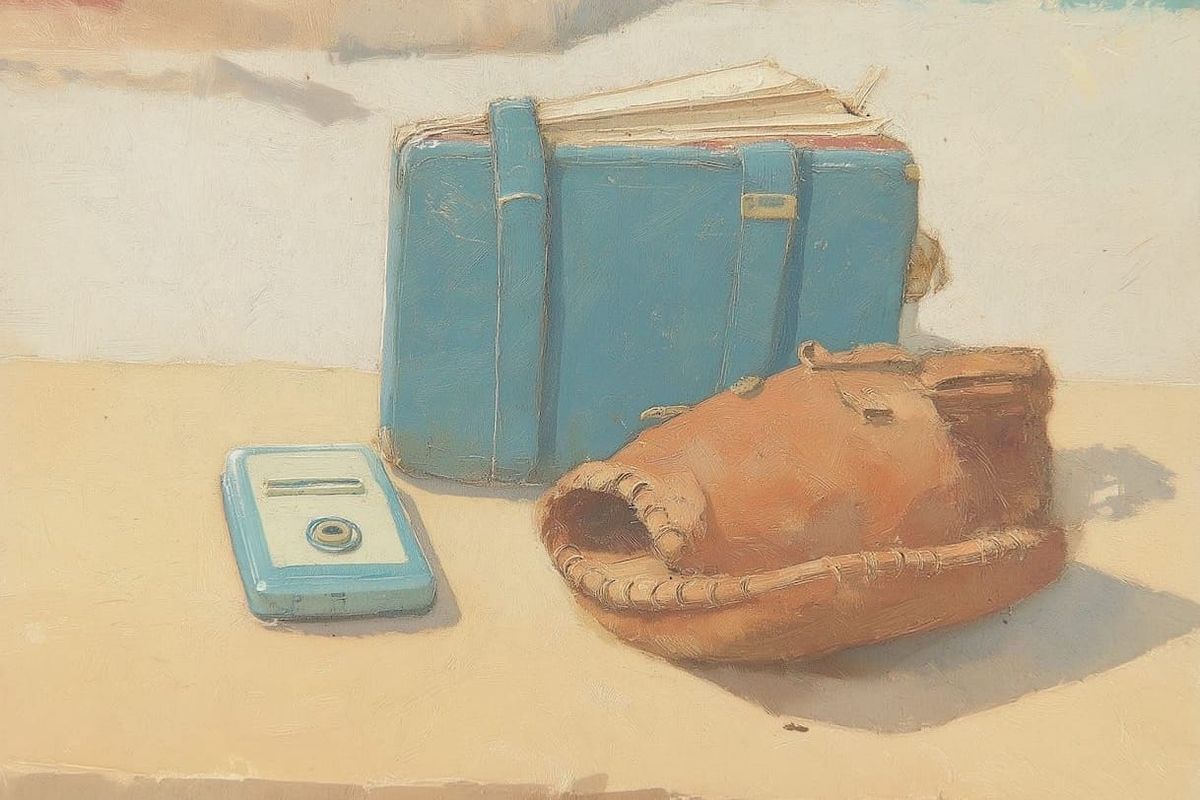
Image prompt: A mid-century illustration in the style of a 1964 World's Fair pavilion poster. Simple still life. Composition: a worn wooden surface in warm late-afternoon light — a kitchen table at home. On the surface, two objects beside each other: a Companion Device and a well-loved baseball glove. The Companion Device is a folio-format personal device in the spirit of Apple's 1987 Knowledge Navigator — closed, lying flat, tablet-sized (roughly the proportions of a small leather-bound agenda), with a hinged spine. Its outer surface is bound in the manner of Hermès leatherwork: deep saddle-stitched leather in a rich blue-black, contrast-thread stitching along the edges, small reinforced corner pieces in burnished brass, a discreet stamped maker's mark near the spine. The leather shows years of careful use — gentle patina along the spine and the edge where the hand grips, a slightly darker tone where the thumb rests, the corners softened from being picked up countless times. No visible screen; the device is closed and at rest. Beside it, the baseball glove: leather darkened in the pocket, lacing replaced, webbing showing the scars of many seasons. The two objects sit in companionable relation, slightly overlapping or near each other, as if both belong to the same person and have been set down together — kindred objects, kindred patinas. Camera angle slightly elevated, looking gently down. Limited mid-century palette: warm citrine yellow in the light, deep sky blue, soft teal in the shadow, terracotta accents, cream. Gouache and screenprint texture, confident color blocks, no photorealism. Optimistic, civic, Carousel of Progress register.
The rest of this letter is for Dynamo members — the people building plenty with us. If you're reading as a guest, you're welcome here. But the best seats on the Carousel are reserved. Join the Dynamos.