
The Living Home
How it feels to live in a home that gets better with time, and what it takes to make one. Why the dwelling is the test case for better living with circularity.

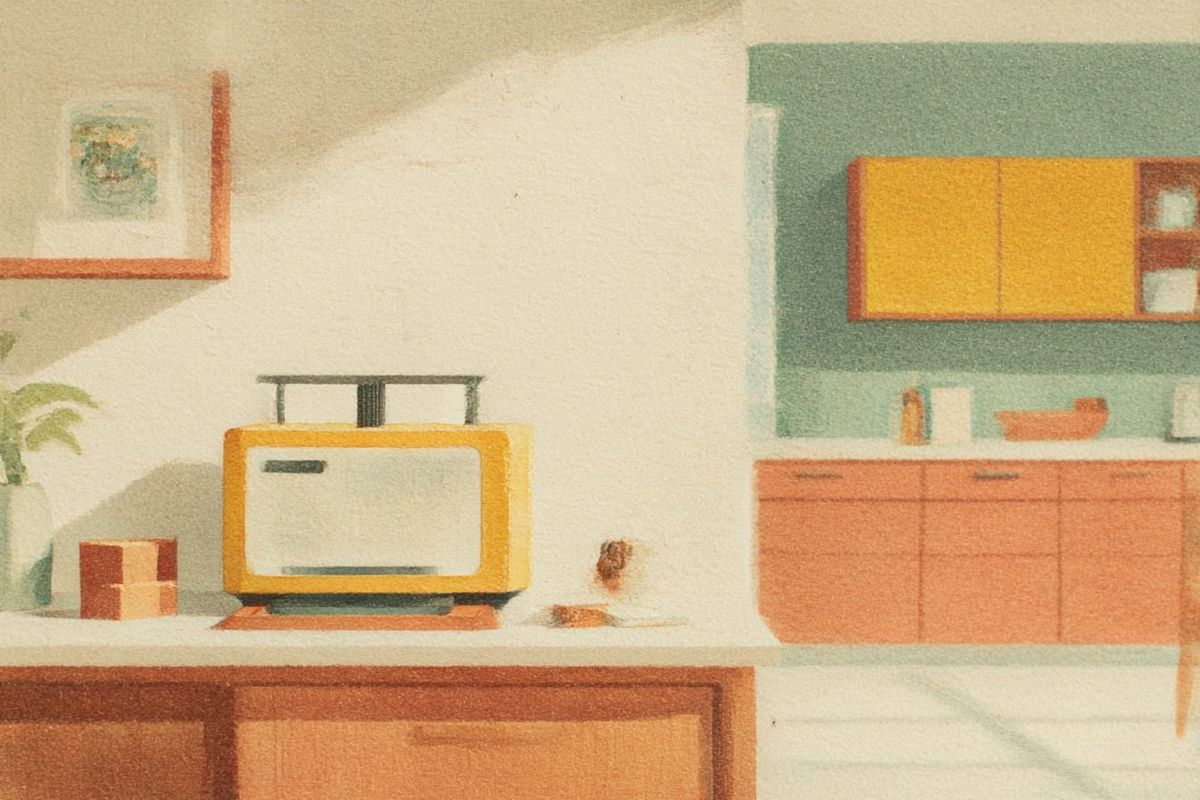
This letter is part of the Carousel of Plenty, a series exploring products and services that could only exist in the Circular Century. We talk a lot about circular transformation — why it matters, how it works, what it demands of leaders. This season, we show you where it leads. Each essay presents one solution: something you'd use, live with, or depend on in a world designed for permanence rather than disposal. The premise is simple. The linear economy promised progress and delivered volume — more things, fewer of them worth having. The Circular Century delivers plenty: the precise amount that satisfies without burdening. These are its furnishings.
Made to Last. Made to Grow.
Now, sit down a minute. Let me show you something.
You see that cooktop? Twelve years we've had that thing. Twelve. Mother was making Sunday stews on it back when the kids brought home works of art in the medium of finger paint. Now they're doing homework on the laptop, and that same cooktop is humming along like the day it was delivered. Actually, it's better than it was then, if you ask me. They came out and refreshed the parts inside last spring — made it smarter — and now it cooks Mother's stew better than ever. (Don't tell her I said that.)
When the kids were little, we lived in the bungalow over on Maple. Now we're here, with the porch and the room for the dog. You know what came with us? The kitchen. The whole thing, near enough. Cabinets came apart like a puzzle and went right back together in the new house. Same cabinets. Same kitchen. New chapter.
The thermostat learned the children's school bus schedule — runs the floor warm before they're out of bed. The heat pump out back called the company before it gave out; the part showed up two days ahead of the trouble. The dishwasher is on its second motor. It's still on its first relationship with this family. It's seen every Thanksgiving since our old dog was a puppy.
This is how it feels to live in a home that gets better.
Not because we're better at fighting the chaos. Better because the home was made for the long run — built to be fixed when it needs fixing, built to grow when we need it to grow. The clever bits inside, the ones folks used to tell you were too complicated to repair? They open right up. Send a part back, get a new one in the mail. Easiest thing in the world.
Now — we used to call this rich-people stuff. The architect who came back every five years. The carpenter who knew the family. Houses made for people, over time, that got more themselves with every season. The kind of life that used to require an inheritance.
Well, friends, it doesn't anymore.
We love this house. And you know what?
It feels like it loves us back.
For the Consumer
What changed in that kitchen is not the appliances. It is the home's posture toward the people living in it.
The Living Home works subtly on your behalf. It actively engages you as a partner in the act of maintenance. It manages itself, with the makers it is in covenant with. The heat pump does not page you when it fails. The heat pump tells the manufacturer it is going to fail, and the manufacturer dispatches the part. You learn about it when the technician schedules their visit.
There is an old Disneyland principle behind this. John Hench used to say that a guest's pleasure depended on never being asked to absorb a contradiction. In the linear-economy home, every appliance leaves a contradiction in your hands: the maker gets paid to sell, not serve. In the Living Home, the contradictions resolve before they reach you. The home is reassuring the way a good park is reassuring. Every detail has a partner.
That is one register. Here is another.
Stewart Brand identified six layers in a building — Site, Structure, Skin, Services, Space plan, Stuff. The work of the home, he said, is to let those layers move at their own different paces without tearing each other apart. There is a seventh layer he considered for the list: the Soul. The resident. The reason any of the building exists.
In a linear-economy home, the Soul is servant to the Stuff. Each thing was sold to live alone — designed for itself, not for the rest of the house, and not for the rest of the resident's life. As the years pass, the makers move on. The resident is the only party left in the relationship.
📦 In a linear-economy home, the Soul is servant to the Stuff.
Brand once described the kind of relationship a person can have with a horse — that you take care of a horse and, over time, the horse takes care of you back. The reciprocity is what makes a horse a horse and not a machine. Most of what we live with does not care back. The Living Home is the proposition that some of it can.
Hench's home protects you. Brand's home engages with you. The Living Home does both. The linear-economy home does neither.
Christopher Alexander wrote books about how houses ought to grow with the people in them. Each pattern was small — a window seat, a sunny corner, a defensible private place — but they built up to a humane architecture, a dwelling that became more itself the longer you lived in it. He thought everybody deserved this. He also thought it was effectively unavailable to anybody who could not afford to keep an architect on retainer.
Composability shifts that budget line for the better.
If the parts of the home are swappable — if the cabinet's joints are standardized, if the cooktop's parts can be ordered in the mail, if the thermostat speaks to the heat pump in a protocol that did not exist when the heat pump was built — then the adaptation gets cheap. A translator layer between the old part and the new part keeps the home working while you change one piece at a time. Brand's pace layers stop tearing at each other.
This is the principle Enzo Mari was after with Autoprogettazione — boards, nails, a manual, a chair anyone could build. It is the principle Adam Savage demonstrates every time he takes apart a flashlight on camera. That is composability outside of commerce. Circularity brings composability inside of commerce.
The Living Home is the result: every season the home gets a little more suited to your life. More yours.
Live in a home like this for a few years and a after a while it teaches you some of the benefits of living in the circular economy.
It appreciates rather than depreciates. Every refresh of the parts, every firmware update, every chassis swap is an addition. You are accumulating the home with your life rather than maintaining it against entropy.
It composes well. Standardized interfaces, swappable parts, addressable components. The dishwasher gets a new motor without losing its history. The thermostat gets a new face without losing the children's birthdays.
The maker stays in the relationship. The producer is paid to keep you flourishing across decades, not to sell you a replacement. Durability is a property of the relationship as much as a property of the object.
Calm permanence settles in. The kitchen is settled. The heat pump is settled. The thermostat is settled. The low-grade dread about which subscription auto-renews and which firmware is about to lapse — gone.
Time stops being a threat. The cooktop is older today than last winter and still good. The cabinet is older today than last winter and still good. The years are something the home accumulates with you.
The dwelling that gets better with care used to require an architect, an inheritance, and a team of people whose names you knew. The privilege was not the granite countertops. The privilege was the posture — a house tended to by people who would still be there next year.
The Living Home is that privilege made accessible. Care, over time, from people you trust — now available across the whole market.
It is the upper-pyramid product category. The first to ship at scale.
By the Producer
This section uses Roger Martin's Strategy Choice Cascade — Winning Aspiration, Where to Play, How to Win, Must-Have Capabilities, Enabling Management Systems — followed by the "What Would Have to Be True" (WWHTBT) test that reveals why this solution can only exist in a circular economy.
The Living Home is the first appliance category in which the Three Dynamos of the Circular Century all run at once.
The Three Dynamos are the enabling catalysts of the Circular Century — the technological forces that turn circularity from an aspiration into a working business model. They are:
- Distributed Power — energy generated close to where it is used, owned by the people who use it.
- Ambient Intelligence — software and sensing that let every object in the home listen, learn, and coordinate with every other object across its life.
- Recombinant Matter — materials and components designed from the start to be refreshed, reassembled, and returned upstream.
Each Dynamo has been advancing on its own track for some time now. The Living Home is what happens when those tracks finally cross at the consumer level — and the producer who can run all three Dynamos inside a single category is the one positioned to deliver this convergence to the household.
The producer archetype is the appliance-as-platform company. It vertically integrates battery cells, inverters, power electronics, embedded compute, and grid services. It markets the appliance to the consumer; it licenses the platform to OEMs through Powered-by-Platform programs. Impulse Labs is the legible vanguard. Founder Sam D'Amico's Impulse was never a stove company is the spine of the strategy. The stove was the wedge. The platform is the play. The virtual power plant (VPP) is the disruption from below.
Let's run the appliance-as-platform company through Martin's Strategy Choice Cascade.
Winning Aspiration. Become an operating layer of the Living Home — the company whose products run all three Dynamos inside the appliance and earn a multi-decade revenue relationship with every unit the platform powers.
Where to Play. High-friction, established appliance markets where iteration cycles are long, regulatory bars are real, and incumbents are slow. Cooking first; the wedge is sharpest where the panel constraint hurts most. Heating, cooling, water, drying, EV charging next. North America first. Geographies with grid stress and policy support second.
How to Win. Synthesize the Local Buffer as a productized layer. Bypass the Services-layer constraint at the home — no panel upgrade required, the buffer lives inside the appliance. Become the certified, default-installed energy storage in every electrified appliance category. License the architecture to OEMs through a Powered-by-Platform program so the platform reaches beyond the company's own developing retail channel.
Must-Have Capabilities. Cell sourcing and pack engineering. Power electronics. Embedded firmware on a multi-decade upgrade horizon. Grid-services partnerships and VPP enrollment. A service network for cell refresh and pack swap. Design for disassembly. Material passport. Multi-decade financial modeling. The capability list reads more like a utility's than a consumer-electronics company's, which is the point.
Enabling Management Systems. Capital structure aligned to multi-decade obligation rather than the VC exit horizon. Engineering culture that designs for swap-and-refresh from day one. A customer-service organization closer to Otis than to Whirlpool. A diplomatic posture toward OEM partners, regulators, and utilities — closer to statecraft than to sales.
Now run the WWHTBT test. For the appliance-as-platform model to succeed, four conditions must be true simultaneously.
1. All three Dynamos operating. Distributed Power topology supported by grid and home. Ambient Intelligence routable into the appliance. Recombinant Matter at cell, pack, and chassis. Designed in from day one. Retrofitted later does not work.
2. A buyer posture that is not TCO. Consumers do not run Total Cost of Ownership analyses. They evaluate something else. The producer's value proposition is Lifetime Joy — the promise that the appliance will be a source of pleasure across decades rather than a depreciating obligation. The producer's success condition is Total Joy of Ownership (TJO) — the cumulative satisfaction the asset generates across its life, measured by the producer rather than the customer. The buyer chooses the appliance because she wants the relationship. The spreadsheet does not enter into it. This is the most fragile assumption in the model and the most important. Without it, the appliance is just a more expensive stove.
3. Translator-layer infrastructure available. The Local Buffer must be productizable. Cells must be cycle-able. Packs must be swappable. Firmware must update across decades. Standards must let the home speak to the grid. Some of this is endogenous to the company. Most of it is not.
4. Capital structure that pays the maker to stay. Not VC. Patient strategic capital, infrastructure-grade debt, customer prepayment, long-tail service revenue. Different in shape from any structure currently funding consumer hardware at scale. The capital is the thing that decides whether the relationship is a covenant or a sales transaction. Get this wrong and the whole stack collapses into another Fisker.
All four must be true at once. Remove any one of them and the model fails. Remove two and the model never gets started. Which is why this is genuinely circularity-only economics — not retrofitted sustainability, not linear-with-trim. The Living Home is the appliance category the industrial economy has not previously been able to deliver, because the company that ships it has to be a new kind of company — transformed to thrive in the Circular Century.
Image prompt: A vintage mid-century advertising illustration in the
manner of a 1960s World's Fair poster, gouache and
screenprint texture, flat color areas with clean edges,
warm optimistic palette of citrine yellow dominant with
sage green, soft terracotta, and sparing teal accents,
retro-futuristic consumer optimism — depicting a quiet
sun-filled corner of a family home interior at late
morning, no figures. In the foreground a wooden workbench
against a cream wall, a small desktop 3D printer in
citrine yellow extruding a clearly modular geometric
component, a few finished modular parts on the bench.
Soft daylight. The open plan extends into the soft middle
distance: a glimpse of a kitchen with modular wood-toned
cabinetry and a single citrine yellow accent panel
The rest of this letter is for Dynamo members — the people building plenty with us. If you're reading as a guest, you're welcome here. But the best seats on the Carousel are reserved. Join the Dynamos.