Energy Sovereignty
The household has been at the far end of a long fragile string for a century. Energy sovereignty is the move out. Solarpunk 2.0, and the triad that builds it.

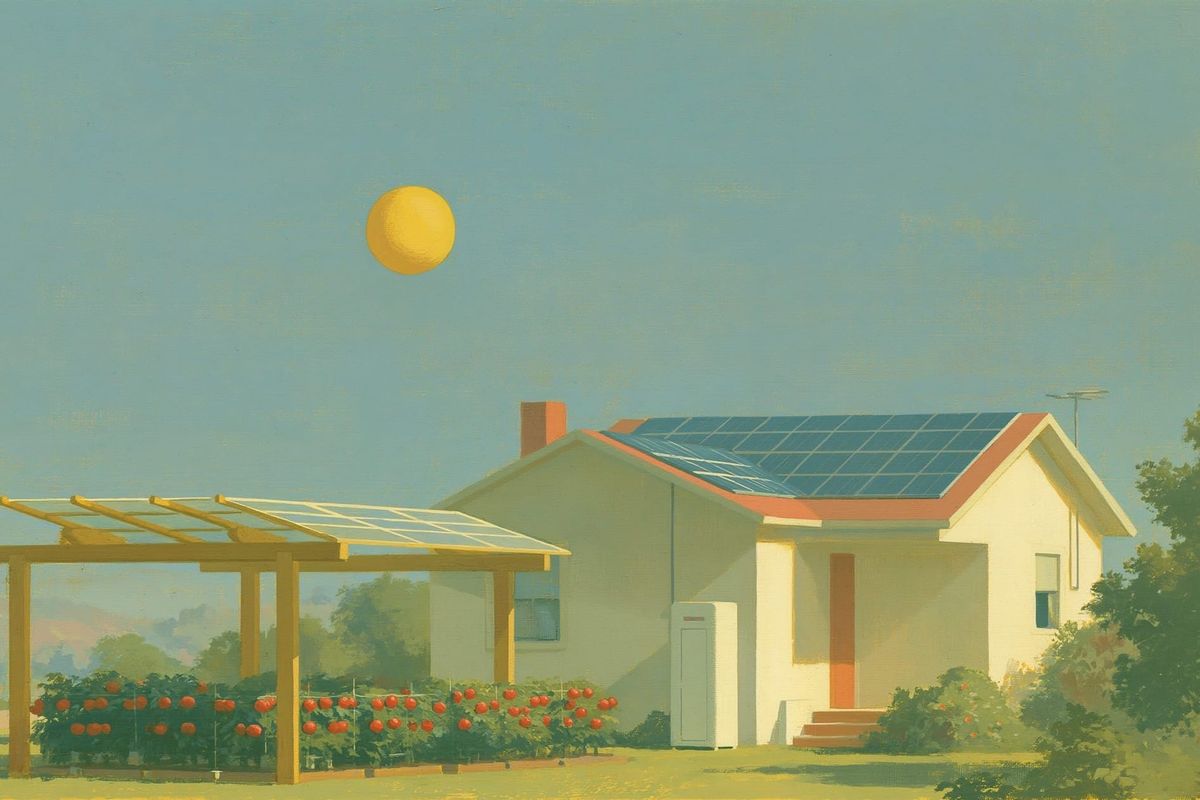
This letter is part of the Carousel of Plenty, a series exploring products and services that could only exist in the Circular Century. We talk a lot about circular transformation — why it matters, how it works, what it demands of leaders. This season, we show you where it leads. Each essay presents one solution: something you'd use, live with, or depend on in a world designed for permanence rather than disposal. The premise is simple. The linear economy promised progress and delivered volume — more things, fewer of them worth having. The Circular Century delivers plenty: the precise amount that satisfies without burdening. These are its furnishings.
Yours to Make. Yours to Share.
Now, pull up a chair. Sit a minute. Let me tell you something Grandpa would not believe.
He used to talk about the feeling he'd get when the utility bill came in. He'd ask Grandma to nudge the air conditioning down. Take a quick cold shower instead of a long warm one. Help him through the summer. He'd open that envelope standing up.
Our bill came in last Friday. Forty-two dollars. In August! In Springfield! Mother set it down on the counter the way you'd set down a grocery receipt.
Now, here's the part I really like. Some weekends, the meter runs the other way. I tell the kids and they gawk like I'm doing a magic trick. They lean over to watch the little numbers turn — and the little numbers go backwards.
I'll tell you what it is. We make some of the power, you see. We share some of the power. And on a sunny weekend, we sell some of it. The roof is doing it. The trellis over Mother's tomatoes is doing it — the same trellis that shades the vines from the worst of the afternoon sun. Down at the corner, a little outfit knits us all together with the company — they handle the rest.
You know what Mother said about it the other day? She said it's like the tomatoes she grows out back. Some folks buy tomatoes at the store. Mother grows them in dirt that belongs to us. They taste better. They cost nothing. That's what the electricity is now. Out of the sky and into the lamp. Satisfying and free.
Grandpa would not have believed it. The sun scared him every August. Now it runs our porch fan while Mother brings in the tomatoes.
A new kind of freedom, friends.
A new kind of plenty.
For the Consumer
The bill that came on Friday is not the only thing that has changed. The relationship geometry has.
For most of the twentieth century, the household stood at the far end of a very long string. At the other end were fuels, mines, ports, pipelines, and large machines burning what those mines and ports delivered. Anything that happened along the string showed up at the far end. A tanker rerouted; the bill went up. A storm knocked down a transformer fifteen miles away; your refrigerator went warm. The household was the last node on a long, fragile filament, most of it somebody else's concern. The fragility of that arrangement is what Grandpa was sensing when he opened the envelope standing up.
Last week's letter explained how Stewart Brand observed that buildings are made of "shearing layers" that move at different speeds. He extended the same observation to civilization itself: pace layers. Fashion moves the fastest — experimental, volatile. Commerce moves more slowly. Infrastructure — roads, networks, the grid — moves more slowly still, constrained by cost and complexity. Governance is slower again. Culture moves over generations. Nature is the slowest of all. A healthy civilization lets each layer keep its own pace without interfering with the others.
Energy is unusual in that it touches every one of those layers at once. Nature makes the resource. Governance makes the rules about it. Infrastructure delivers it. Commerce sells it. When the layers move in concert, the bill is just a bill. When the layers fall out of phase, the bill becomes a window onto a system in trouble.
That is the system Grandpa was reading. Nature was breaking down faster than the rest of the system could absorb. Governance was chaotic. Infrastructure was aging out. Commerce kept selling a dying dream. The friction between the layers reached the household as a rising bill and a brittle line.
Bill McKibben has written about what happens when energy stops being a resource you ship and becomes a flow you receive. The sun and the wind, he points out, are diffuse and everywhere. They are difficult to hoard. They are difficult to fight wars over. He is describing a deep reordering of the planet's power systems — power in both senses of the word. The household scale of that reordering is what Grandpa would not have believed. The geopolitical anxieties that used to get into his utility bill cannot get into ours, because there is no string for them to travel down.
Bill Nussey has the cleanest way of putting the underlying shift. Solar, wind, and batteries are technologies, not fuels. That single sentence reframes the entire household conversation. A fuel obeys the resource curve — finite, fought over, priced by scarcity. A technology obeys the learning curve — abundant, improving, priced by manufacturing volume. A household with a furnace is buying fuel forever. A household with panels and a battery has bought a piece of the learning curve and gets to keep riding it for decades. The roof and the solar trellis are not generators in the old sense; they are durable goods that produce a service.
Energy sovereignty is power at the speed of art, or at least, of a harvest. Power generation moves to the rooftop and the solar trellis. Storage moves to the wall. The neighborhood block becomes the buffer. The household loosens the string that runs through the world's troubles.
Earlier this year we wrote about the punk's discipline of ordering one's own corner — making the small things in your own life right when the larger world refuses to be made right. Are You a Punk? was about the moral posture. Energy Sovereignty is the same posture rendered in watt-hours. The household that generates and stores and shares its power opposes chaos the same way: tending the small zone of order that is actually under one's own care. Solar panels turn out to be a moral instrument and not just an electrical one.
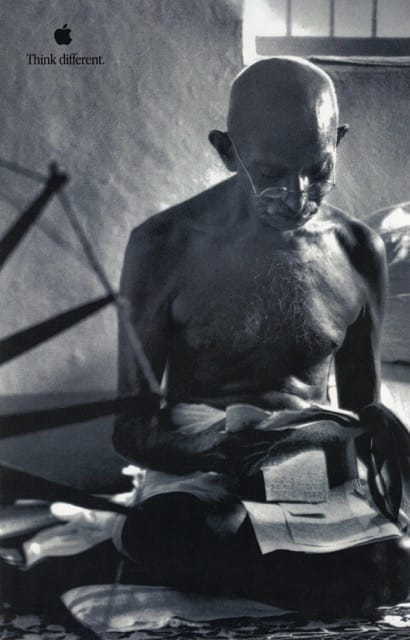
In 1997, Apple's Think Different campaign placed Gandhi-at-the-spinning-wheel in a pantheon with Einstein, Picasso, and Martin Luther King. The image was carefully chosen. The spinning wheel was not a symbol of nostalgia, but an instrument of nonviolent resistance — the sovereignty of a household and a village over the production of its own fabric, with everything that implied for the empire that depended on selling cloth back. With Think Different, Apple gave a name to a lineage of tools for noble rebels. Energy Sovereignty belongs in that lineage. The solar trellis on the back of the house is the same gesture the spinning wheel was, applied to a different essential of daily life.
Two engines drive this kind of change, and both are running.
Douglas Holt has shown that powerful brands win their place by speaking to the gap between the official story of a culture and its lived experience. Friction between pace layers can widen that gap. The official story of the legacy utility was reliable, modern, civic infrastructure. The lived experience was expensive, brittle, and hostile to participation. That gap is exactly the territory a narrative of rebellion fills.
Clayton Christensen has shown that disruption arrives from below — worse on the metrics incumbents care about, better on the metrics incumbents ignore (but a new movement of customers value). Behind-the-meter solar-plus-storage was, for decades, worse on capacity factor and unit cost. It was better on resilience, predictability, and sovereignty.
Both engines were turning quietly for two decades. Their historical moment has arrived.
What they are turning into has a name. Solarpunk 2.0 is an evolution. It is a working system with a household-scale entry point, powered by the sun. Mother grows the tomatoes. The solar trellis throws the shade and catches the photons. The block keeps the lights on through a storm. The bill is small. The dread is gone.
That is the consumer's experience. Now we have to look at how the producer makes it possible.
By the Producer
The household experience above rests on three producers, not one. Treat them as a stack:
- Household-scale hardware — the rooftop array, the solar trellis, the storage in the wall, the smart panel. Behind-the-meter where regulations are sticky; standard interconnect where they are not. This is what the resident sees and touches.
- Block-scale microgrid operator — the long-term steward. Aggregates a row of households into a coherent prosumer at block density. Carries the diplomatic burden across utilities, regulators, and residents across decades. Otis-shaped: an institution that stays in the relationship after the equipment is installed.
- VPP coordination platform — the Ambient Intelligence layer that turns aggregated households into a market participant the utility can transact with.
None of the three works at scale without the other two. Together they make virtual power plants profitable, performant, and robust. The triad's posture toward the legacy utility is complementary, not adversarial: it reduces substation costs, smooths demand, supplies generation closer to load, and shortens the interconnection queue. Conservation becomes an option for the resident, not an obligation. The utility that recruits the triad as a partner is doing better business than the utility that fights it.
The role most underdeveloped of these so far is the operator:
Winning Aspiration. Become the long-term steward of the block's energy citizenship. Turn a row of houses into a coherent prosumer. Stay diplomatic across decades.
Where to Play. Geographies where regulation permits behind-the-meter prosuming today and where utility partners are receptive to demand-smoothing and alternative supply. Block density first; mini-grid scale second; community-microgrid scale third.
How to Win. Bring composable household-scale hardware to the resident as a turnkey service. Operate the block-scale aggregation. Hold the VPP relationship with the utility. Promote the partnership to the utility as a substrate that helps it solve real problems — substation upgrades, peakers, queue pressure — rather than fight prosumers about them.
Must-Have Capabilities. Hardware partnerships at the household level. VPP coordination software, built or partnered. A service network for cell refresh, pack swap, and panel maintenance across decades. Diplomatic capability — what From Managers to Diplomats called the statecraft layer. A capital structure aligned to multi-decade obligation, in the Vendor Dependency covenant frame.
Enabling Management Systems. An engineering culture that designs for upgrade paths over decades. A regulatory affairs function that thinks like a foreign ministry. Customer relationships that survive the resident moving away — the asset stays with the address, in covenant with the next resident. A capital plan that is the strategic plan.
For the triad to scale, all of the following must be true at the same time.
All Dynamos of the Circular Century operating:
- Distributed Power as the topology, with renewables as the source.
- Ambient Intelligence routable across the stack.
- Recombinant Matter at the cell, pack, and chassis level — designed in from day one, so the equipment refreshes rather than landfills.
Behind-the-meter prosuming legal and economically attractive enough to bootstrap participation. The interconnection queue gets fixed eventually. The triad cannot wait for it. Plug-in and behind-the-meter forms are the wedge that lets the market move while the queue heals.
Utilities recruited as partners, not opponents. Some will lead. Some will be dragged. The triad's argument is we make your job easier, your peakers cheaper, your queue shorter, your generation cleaner, and your customer relationships better. The utilities that hear this will have multi-decade advantages over those that resist.
Capital in the right shape. Patient strategic capital, infrastructure-grade debt, prepaid service contracts, long-tail revenue. Not VC. Get this wrong and the stack collapses into another rooftop-solar-loan-bankruptcy.
A cultural mythology widespread enough that prosuming reads as citizenship. Solarpunk 2.0 is the multiplier. Without it, the operator faces a market of one-at-a-time hardware purchases. With it, the operator faces a market of communities asking to be served.
Pull any of these out and the triad fails. Which is why this is genuinely circular-only — not retrofitted utility, not solar-as-trim. The triad is the next company structure capitalism is poised to ship at scale. An evolution: better design, better capabilities, better performance. In an earlier letter, Why Self-Disrupt?, we called this a different species of enterprise — built on an improved organizational architecture. The energy case shows what one looks like in practice.
Image prompt: A mid-century illustration in the style of a 1964 World's Fair pavilion poster. Composition: the upper portion of the frame holds a low late-afternoon sun in a saturated golden sky, descending into clear blue toward the horizon. The lower portion holds a single modest suburban home with a pitched roof of integrated solar panels and, in the back yard, a wooden pergola roofed with semi-transparent solar panels shading neat rows of tomato plants below. A slim white battery cabinet sits beside the house. No people in frame. Camera angle is slightly elevated, looking gently down on the property. Late summer, warm golden hour light. Limited mid-century palette: warm citrine yellow, deep sky blue, terracotta, soft greens, cream. Gouache and screenprint texture, confident color blocks, no photorealism. Optimistic, civic, Carousel of Progress register.
The rest of this letter is for Dynamo members — the people building plenty with us. If you're reading as a guest, you're welcome here. But the best seats on the Carousel are reserved. Join the Dynamos.