Coping with Abundance
Every age of plenty before this one was fleeting — squandered by an economy that profits from more. The Circular Century is the first abundance built to stay. Which leaves only the question of how to cope with it.

This letter is part of the Carousel of Plenty, a series exploring products and services that could only exist in the Circular Century. All season we have shown you its furnishings — one solution at a time, things you'd use, live with, or depend on in a world built for permanence rather than disposal. These last two letters set the catalog down and step back to the questions the whole season was built to reach: why this abundance is different from every one that came before it, and what, in the end, it is for. This is the first.
We keep rebuilding one particular summer.
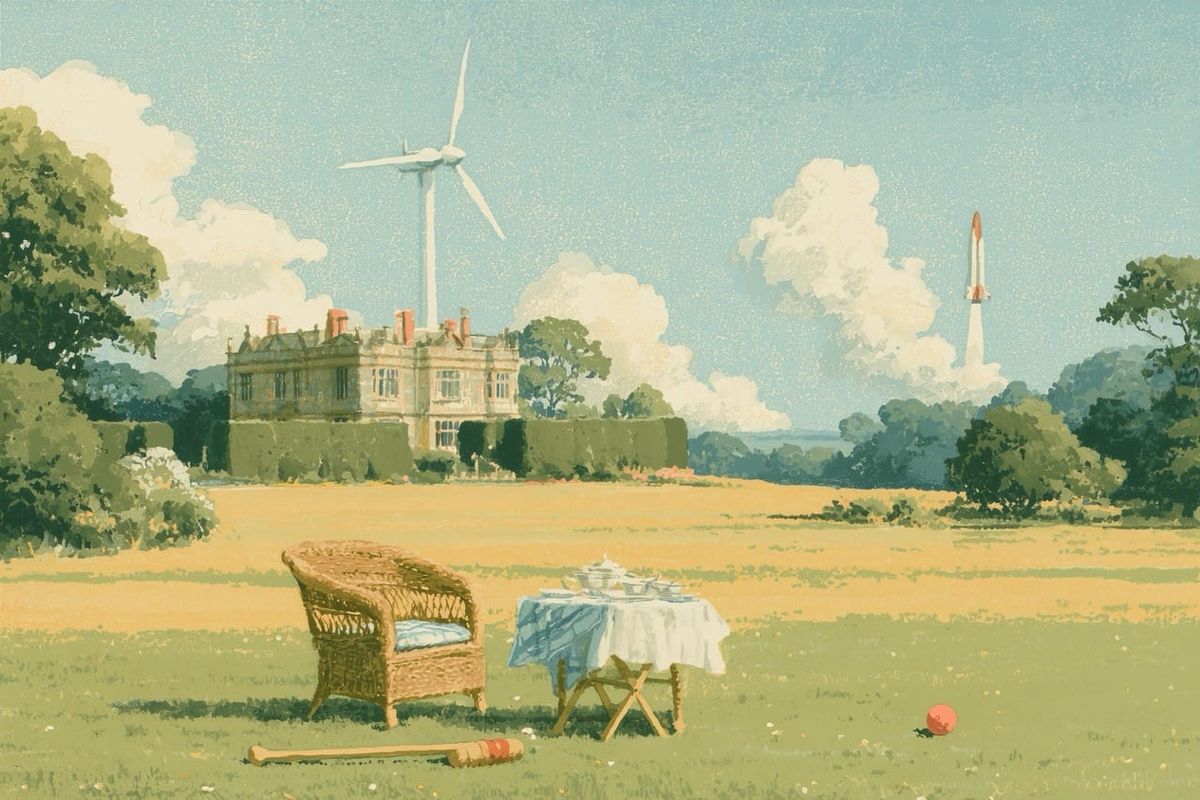
It is the summer of 1913, or a summer like it. A house in the country. A long lawn going gold at the edges. White flannels, a game of croquet nobody is trying very hard to win, with tea. The light is generous. Nobody on that lawn knows that the world which made the afternoon possible has about fourteen months left to live.
We have rebuilt that afternoon in our novels and our films more times than anyone can count. We park our cars in garages and call them carriage houses. We buy suits cut to a pattern perfected in Edwardian tailoring rooms. We are, a century on, still a little in love with a class most of us would have served rather than joined.
Let's be honest with ourselves about it. The love is real and the reasons for it are mixed. So set aside, for a moment, everything that was unjust about that world, because the thing we actually miss is not the injustice and not the money. It is the bearing.
Golden age elegy
The people on that lawn had been handed a rare gift: the question of survival was settled, and they knew it. The matter of staying alive, staying fed, staying warm — closed. What remained was the question of what to do with a life once that weight is lifted. They answered it with literature and philosophy and a code of conduct they took seriously even when they failed it. There was a noblesse to the nobility. They expected to become their best selves, and they expected it of each other.
It was a whole age that prized that kind of self-possession, and it left us these words for it: I am the master of my fate, I am the captain of my soul.
It was something they believed. Do we? I'm not so sure, as a culture, that we do. It sounds, in 2026, like a platitude printed on a motivational poster.
It would be easy to assume a sentiment like that came from that stately lawn. It did not. William Ernest Henley wrote it in 1875, from a hospital bed — the son of a struggling bookseller, one leg already lost to tuberculosis, the surgeons fighting to save the other. He had no estate and no station to fall back on. What he had was a conviction that ran right through the culture of his century: that a person is the author of his own life.
That self-possession grew out of an age the economic engine had made independent. But it settled into the culture, not just the class that benefitted most from it. What reached Henley, several degrees removed from that wealth, was the conviction, not the income. The estate did not travel. The bearing did. A penniless invalid could lay as much claim to it as the gentry, because it belonged to the age more than to any estate, or class. You do not need a long lawn to stand the way Henley stood. You need a moment when the weight lifts — and the nerve to use it.
That summer afternoon was such a moment. The people on the lawn stood between the mean centuries of feudalism behind them and the grubby machine-century closing in ahead, balanced for a while between the two — survival settled, the deluge not yet arrived. The abundance was new enough to enjoy and not yet old enough to take for granted. There was no slouching, literally or figuratively.
And then it was over. The afternoon passed, the way those afternoons do. What we feel looking back — the particular ache of it — is bound up in the brevity: we know, as the people on the lawn could not, how little of it was left. It was a threshold. And the thing about a threshold is that you only ever dwell there for a while.
We had our own threshold, and we miss that too
You do not have to reach back a hundred years to find another one. We had ours, and most of us were there for it.
Picture the years between the arrival of the web and the arrival of the smartphone — call it 1991 to 2007. Information had become cheap and close in a way it never had been, and it had not yet become a flood. You went to the internet, and then you left it, and it stayed there. The phone in your pocket was just for calls.
That threshold has a perfect monument, and it is the television comedy of the era. Seinfeld. Friends. The Office. Watch them now and notice what the characters get to worry about. A bad date. An awkward lunch. Who said what to whom. These are the troubles of people whose survival is handled and whose attention is still their own. They are comedies of manners, which is the kind of story a culture produces when it finds itself, briefly, with room to breathe. They are the Jane Austen novels of the dial-up age. We are nostalgic for them for the same reason we are nostalgic for the lawn.
But again, we should be honest with ourselves. Nobody wants dial-up back. Nobody sane wants the landed estate back. The longing is not for the technology and not for the hierarchy. It is for the balance — for a threshold we were allowed to stand in for a while before it gave way. The ache is not a wish to return. It is evidence of our appreciation of life in the balance. It indicates our longing for a kind of life we keep reaching for and keep losing.
Every threshold has closed, and some closed in the trenches
Because they do give way. That is the bitter fact under the sweetness.
The Edwardian summer ended in the literal trenches of the Somme. The young men from the lawn went into the mud and a great many of them did not come back, and the world that produced the afternoon never reassembled. The threshold did not fade politely. It collapsed, all at once, into the worst violence humanity had yet seen.
Ours is closing too, and we are already in the trenches of it. We are dug into the feed. We fight a daily war of attrition against a flood that never crests — the notifications, the tabs, the refresh, the monetization of our own attention against us. Somewhere underneath all of it is a person who, as I wrote in a letter last season, just wanted to read a book tonight. The abundance of information that once felt like dipping a toe into an ocean of knowledge now feels like drowning. The tide pulled us in. As it always seems to do.
The reason has a name
Why does every threshold end this way? Is it bad luck, or foolish people making bad choices? Or is it part of the design?
Economist Carlota Perez mapped how this works. Each great wave of new technology, she shows, moves through the same stages — an eruption of the new, then a frenzy of money chasing it, then, if we are fortunate, a long stretch of broad prosperity she calls a golden age, and finally maturity and exhaustion, just as the next eruption begins. It is last season's namesake bubble, dignified into a model. The sweet spot — the balanced threshold we keep mourning — is never a place to rest in her account. It is a way-station on a curve that is still accelerating. The frenzy is always coming. The thing always gets overdone.
The engine that does the overdoing has an old name. Jevons paradox: make a thing more efficient or more abundant, and we do not bank the surplus, we spend it on more. Clay Christensen described it more plainly — we husband what is scarce and squander what is plentiful. The cycle has repeated for a hundred and sixty years. It is the reason the lawn became the Somme and the reason why we're drowning in information. Every honeymoon ends because the engine underneath it cannot idle.
I have argued in these pages before that Jevons is a paradox and not a law, and that the cycle finally dies in one specific place: inside the books of a company that earns more by selling less. I will not re-litigate that case here. I will stand on it. Let's stipulate that the link between abundance and excess can be cut, the way harder links have been cut before.
The question this whole season has been circling is the next one. Suppose it can be cut. Suppose we build a real abundance, the Circular Century we keep describing. Is it just the next threshold — wonderful for a while, and then overrun like all the others?
The first abundance built to stay
This is where I want to make a friendly corollary to Perez, because her model presents an opportunity for a variant we are in a position to realize.
Her cycle has a slot for the golden age. But the golden age is always fleeting. The reason is simple: each paradigm in her analysis ran on scarcity. Its returns came from getting more of something other people could not get — more land, more coal, more oil, more attention, more data. Scarcity-capture is a race with no top speed, and a race with no top speed is what produces the escalation, the frenzy, the eventual crash. She never had a paradigm whose returns came from enough.
Circularity is that paradigm. It is the first abundance that is self-limiting by design, and it limits itself in two ways at once. A circle feeds itself: its outputs are its inputs, so it cannot run away into the kind of bottomless extraction that always ended in a wall. And its money is made differently. When a company profits from the long life of a thing rather than its rapid replacement, every avoided sale is margin, and the appetite for more — the engine of every past collapse — is simply not in the building. The restraint is not a virtue anyone has to summon. It is in the wiring.
Think of the difference in the machines. The old economy ran like a steam engine: a violent stroke of power, then a collapse, then another stroke, faster and harder as it grew. The circular economy runs like an electric motor on a battery that fills from the sun. It does not need the explosion. It is happiest at a steady hum, and it can hum for a very long time.
So the threshold need not close. The balance we keep losing — new enough to enjoy, not yet taken for granted — can, for the first time, be the permanent condition rather than a way-station the curve is dragging us past. The window that has slammed on every generation since the steam engine can be made, this time, not to.
A golden age that doesn't contain the seeds of its own collapse: that's the promise of the Circular Century.
A carousel is a circle that does not punish you
We have been living, all of us, on a treadmill. It is a circle. You move and move and stay exactly where you are, and the longer you're on it the harder it becomes to stay there. The raise that wears off. The house that becomes normal. The feed that refreshes. Everyone reading this knows the machine, because no one alive has known anything else. The escalation has been the background hum of every human life in living memory.
A carousel is also a circle. You go around on it too. But there is music, and a child's delight, and the whole point is the going-around. Same geometry. Opposite life. The difference is entirely in the engine underneath — one that wears you down the longer you stay on it, one built to turn at the pace of a song.
The treadmill did not only bury us in things and noise. It took our agency. It turned us into inputs — into the raw material of someone else's growth, measured by what we consumed and how long we stared. You cannot be the master of your fate while you are an input. Stop the escalation, and the condition that made that old couplet sayable comes back. Not the estate. The bearing. The settled question, the room to breathe, the nerve to stand up straight — available now without a lawn, and in a world we are never going to unplug from.
That is the unburdening this season has been promising, and it goes deeper than a clean conscience. A clean conscience is relief from guilt. This is relief from the machine itself.
Which leaves us, at last, with the joke buried in this letter's title. We have spent a whole season describing an abundance so complete, so handled, so calmly yours, that the only thing genuinely left to figure out is how on earth to cope with it. What does a person do with a life when the weight is finally, permanently lifted — when the question is not how to survive, or how to keep up, but simply how to live?
That is next week's letter. For now, it is enough to know that the threshold can become a home.
The rest of this letter is for Dynamo members — the people building plenty with us. If you're reading as a guest, you're welcome here. But the best seats on the Carousel are reserved. Join the Dynamos.