
The Circular Economy: A User's Guide
The summer reading season opens with Walter Stahel's introductory text — a book that reaches for what's still missing: a longing for the circular economy.


Summer is here, and that means it's time for a new season of the Circudyne Letter. I've decided to start a new tradition that lives in harmony with the season: summer reading. My school mandated a slate of books to be read over the vacation. I suppose that while the compulsory aspect was not so welcome, it was nice to have another reason to settle down with books amidst all the celebratory and sensual delights of the season.
I intend to make summer reading an annual event here at the Letter. This year, I'd like to revisit some of the canonical texts informing the conceptual framework of my practice.
The best place to start is at the beginning. The book we'll look at today had the working title Circular economy for beginners. It's by Walter Stahel, who has been mentioned often in these letters and who subsequently reached out on LinkedIn with a link to it.
 Walter R. Stahel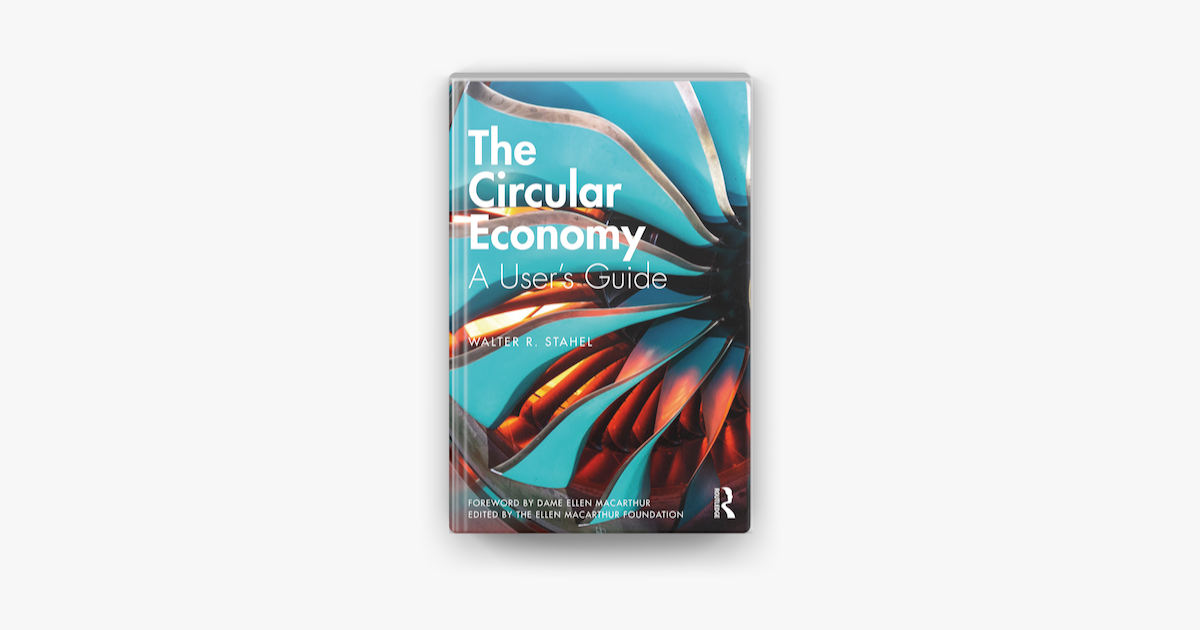
I decided to build a larger list around and behind it — a few core circular-economy texts first, and then some volumes underlying some of the themes of Circudynamics: systems, strategy, Lean, the philosophy of science, the science of beauty and aspiration. If you'd like to follow along, please do. The complete reading list is outlined below.
So the season starts where the field starts. The Circular Economy: A User's Guide is Stahel's summary of his work leading up to the concept of circularity as we know it today.
In the very beginning of the book, he invokes his muse. He quotes Saint-Exupéry:
When you want to build a ship, do not begin by gathering wood, cutting boards and organising work gangs, but rather create the longing for the sea, awaken within men the desire for the vast and endless sea.
The shift to a circular economy, Stahel says, depends on that same longing — a bottom-up desire strong enough to make the whole transition self-propelling. He sets the question at the front door of his own book.
Does he answer it? Hold that thought.
An economy built around "YOU"
Stahel thinks in epochs. For most of the human story, circularity needed no advocate, because scarcity compelled it. When a castle outlived its politics, its stones became bridges. Then coal and iron broke the constraint, leading to what he calls the Linear Industrial Economy. With that framing, he strips the linearity of any vestige of being the natural order of things. It's one epoch among several — a 250-year experiment, bracketed on one side by the circular society of scarcity and, if he has his way, on the other by a Circular Industrial Economy of abundance. The old circularity was imposed. The new one must be chosen.
The work happens in two theaters. "The era of 'R'" keeps objects at their highest value and utility: reuse, repair, remanufacture; technological upgrade. "The era of 'D'" recovers molecules at their highest purity: de-polymerize, de-alloy, de-laminate, de-vulcanize. I was struck by how completely these two era-names carry this book on their shoulders, far more prominently than in any of the later literature on circularity I've encountered.
The theme runs through every chapter. Manage stocks. Maintain value. Let use value take the throne that exchange value has held since the beginning of the industrial age.
Stahel's device against thesis sprawl is a recurring line, and it is endearing and somewhat startling: "The centre of the circular economy is YOU." His emphasis. Then he specifies:
- YOU, the owner-user, keeping what you own in service instead of tossing and replacing.
- YOU, the owner-manager of used objects, dismantling and remarketing.
- YOU, the salesman, backing your goods with lifetime repair.
- YOU, the policymaker, closing the liability loop.
- YOU, the manager of a fleet.
By the closing pages it is simply you and me. The book calls us where we are. Every reader leaves with an assignment, and nobody gets to be a spectator.
A certain kind of caring
And what is the nature of the assignment? A shared remedy: caring. A specific kind of caring, to be precise. His origin story is the Saxon foresters of 1713, where the word sustainability was coined by men who tended forests because forests were the source of their wealth. His household example is Pirsig's motorcycle. His industrial example is Rolls-Royce, watching its engines in flight enabling repair while on the wing. This is husbandry — a long, custodial, economically interested relationship with a stock. You take care of the thing because the thing takes care of you.
Somewhere in the margins of chapter one, I made this note: caring is a substitute for planning. It may be the book's hidden message. Nature has no master plan, Stahel observes, and neither did the circular economy of scarcity. What it has instead is millions of custodians, each holding a long relationship with a stock of things (and presumably, with each other). Caring acts as, or at least stands in for, the distributed governance that hasn't fully shown up yet for a transition to a circular industrial economy.
Reflections
Read through the lens of Circudynamics, the book grounds arguments in systems language that I have been making, if I'm honest, from intuition and experience. His account of premature obsolescence and restricted repair is his characterization of manufactured dependence. His regional workshops remanufacturing mass-produced goods parallel the atelier. And one sentence near the end was striking: if users had a voice and were heard, he allows, they could become the major change agents of the shift. There is the Circudyne hypothesis, endorsed in passing. He plants the flag and moves on.
We differ, honestly, in two places. He expects the circular economy to substitute labor for energy; I think energy and machine intelligence are getting too cheap for that trade to pencil out. He files desire under sentiment — vintage-car rallies, heritage pride — and treats it as a minor driver. I think joy is the major one. But these are quarrels inside an agreement.
Longing for the sea — not quite.
Stahel is modest. He concedes his invocation to the muse goes unanswered. The book has structured and illustrated the principles of the circular industrial economy, he writes — but it may not have answered how to create the longing for the sea. His remaining suggestion: perhaps moving the legal gateposts — depreciation schedules, liability rules, taxing resources instead of labor — is how policymakers might spark some interest.
A great economist walks to the edge of his discipline, and sees in the final step a choice between persuasion and compulsion. He chooses regulation. I'm more interested in where he started: by creating a longing for the sea.
The concession matters, because the metaphorical longing to which he refers is a stand-in for something fundamental. Stahel admonishes us to remember that the circular economy is about economics, and it's hard to argue against that. But economics involves the study of the relationship between supply and demand, and this book — like the field its author helped create — is a supply-side masterwork. Reverse logistics, remanufacturing returns, liability loops, mini-mills: supply, supply, supply. Demand is delegated to policy and to poetry, and so nobody owns it.
My operating hypothesis — for this essay and for Circudyne — is that this is the field's debilitating blind spot, and it explains much of why a sensible, profitable, natural next epoch keeps failing to take hold.
It's worked out backwards: the engineers built the ship. But hardly anyone is longing for the sea.
No showroom
As Stahel puts it: the circular industrial economy has no showroom. The linear economy is practically made of showrooms — the auto salons, the launch keynotes, the whole luminous apparatus of the point of sale. Circular work as presently conceived and practiced is quiet, local, dutifully whispered mouth to ear. No stage. No window display. No place where longing gets manufactured.
Past epochs handled this differently. When the industrial future needed to spark demand, it built showrooms the size of cities. The great expositions — above all in 1939, where the World of Tomorrow turned a picture of prosperity into a dream that a nation later fulfilled and surpassed — did for their century exactly what Stahel says our century is missing. The Circular Century deserves one of its own.
That is a longer argument, and readers of this letter have watched me make it for over a year now. Stahel's honesty is instructive. The field's user's guide ends by calling for a longing it fails to create.
Creating that longing is the work of this moment.
Summer Reading 2026
- Stahel, The Circular Economy: A User's Guide.
- McDonough & Braungart, Cradle to Cradle + Benyus, Biomimicry + Stahel, The Performance Economy.
- Meadows, Thinking in Systems.
- Forrester, Industrial Dynamics.
- Popper, The Logic of Scientific Discovery + Kuhn, The Structure of Scientific Revolutions.
- Martin, Playing to Win.
- Christensen, The Innovator's Dilemma + The Innovator's Solution.
- Womack/Jones/Roos, The Machine That Changed the World + Ohno, Toyota Production System + Deming, Out of the Crisis.
- Alexander, A Pattern Language + Brand, How Buildings Learn.
- McLuhan, Understanding Media.
- Fadell, Build.
- Hall, Where Is My Flying Car?
Image prompt: First-person point of view from a quiet New England beach looking out to sea, an elegant modestly-sized sailing sloop plowing the waves in the far distance, a single closed navy-blue hardcover book resting on the pale warm sand in the near foreground, dune grass at the margins, calm bright summer daylight, gentle surf and a broad open sky, mid-century travel-poster illustration style, 1960s World's Fair poster aesthetic, bold confident graphic design, flat color areas with clean edges, warm optimistic palette anchored by citrine yellow (#FEC400) sunlight with teal (#00B7B0) sea and sky, deep space navy (#1B2951) for depth and the book, a small coral red (#F14432) spot accent on the distant hull, pearl gray negative space, gouache and screenprint texture, serene and inviting, no people, no text
Below the line: the equipment — three arguments this book puts in your hands — plus the takeaway and a preview of next week's reading.