
Playing to Win
Strategy is a choice, so you might as well choose to win. For circularity leaders, the framework offers an opportunity and a moment of truth.


This season's Roger Martin appreciation theme culminates with Playing to Win (2013), the eponymous volume based on the strategy framework copiously cited in these letters and relied upon in our transformation architecture. Credited both to A.G. Lafley and Martin, the book is a memoir as much as a manual: the story of P&G's choices between 2000 and 2009, told by the chief executive who led it and the strategist he called his "alter ego and partner."
 A.G. Lafley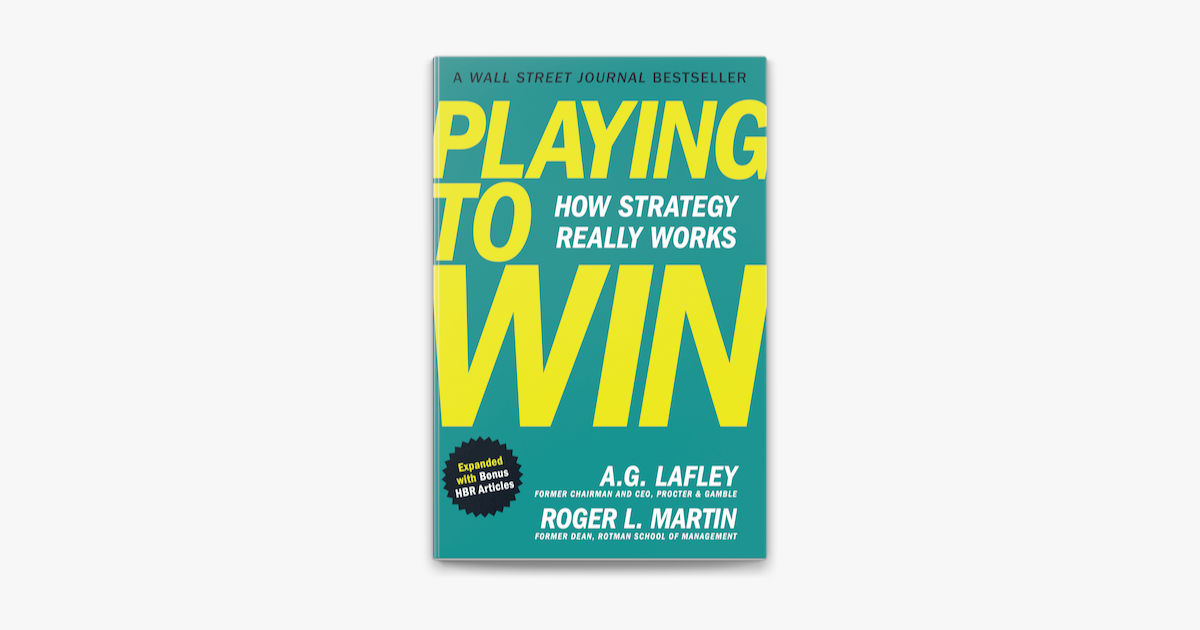
I am a regular and, obviously, ardent reader of Martin's practitioner essays, so much of the book was as expected. But there were at least a couple of enlightening surprises: an origin story, which I will cover below; and a realization about what kind of object this book is. It is a realized artifact of strategy.
And it was refreshing to dive back into the world of P&G in its heyday.
There was also one major unexpected synthesis about moments of truth that is of particular relevance to the task of circularity transformation.
Five choices — and a product
Strategy, the authors insist, is a dynamic concatenation of questions to be answered: What is your winning aspiration? Where will you play? How will you win? What capabilities must be in place? What management systems are required? The middle pair — where to play, how to win — is the heart, and the five form a cascade in which choices at the top set context for the ones below, while the ones below reach back up and revise the top.
As innovation, Playing to Win is sustaining. It presents itself as an agile synthesis of prior work: it cites Michael Porter's five forces and activity system, the fork between cost leadership and differentiation. The book is dedicated to Peter Drucker, whose immortal lesson is translated into P&G's house dialect: the consumer is boss. The cases are lively and relatable — Olay rebuilt to serve a new segment, Gillette learning India by shaving alongside its customers, a diaper priced for parity with an egg.
The remarkable thing about this book is that it exemplifies its method. It is a product, not a treatise. Lafley's objective was to make strategy accessible across an organization, easier to communicate, repeatable at every level, from the company to the category to the function. Both authors praise the approach in terms you would use for a well-designed good. P&G codified its brand-building craft as a framework called BBF 1.0 and shipped upgrades through 4.0, the way it shipped Tide improvements — or software updates.
For Lafley and Martin, the practitioner is their consumer. Their prescription fits a credible diagnosis. It is accessible, without sacrificing depth.
Ego is the enemy (of strategy)
The most delightful part for me was learning the origin story of a keystone concept.
Early in his career, Martin sat with a mining company facing a brutal choice: shut the operation down, or invest to save it. He had a strong view about which option was best. He had just dealt with a client who fatefully and catastrophically ignored his advice in a comparable situation; that experience weighed heavily and he wondered if the cycle was about to repeat. It stressed him out.
Then came his career-making realization. It did not matter "a whit" what he thought. The people around the table — the mine managers on one side, head office managers on the other — were the ones who would have to act. His opinion, however good, could not do the acting for them. His job was to serve them.
Out of that diminution of ego came the "most important question in strategy": what would have to be true? Not what do I believe. Not who is right. For each option on the table: what would have to be true — about customers, about capabilities, about costs — for this possibility to be a great choice? The question removes the self from the argument so the argument can work. In the process the book builds around it, skeptics are asked to name the exact source of their skepticism instead of denouncing the idea. No one owns a possibility, so no one has to die on a hill for one. Opinions about whether the conditions are true are, in the authors' word, counterproductive; the work is identifying the conditions and testing the shakiest one.
Last week I called Martin a philosopher's strategist, or a strategist's philosopher. He lives up to that again this week. The fact that the Playing to Win approach to strategy came from an act of ego destruction comes as no surprise. The philosophy and the strategy are the same move.
The story provides an unexpected coda for last week's letter. A Popperian conscience is hard for humans because refutation feels personal; what-would-have-to-be-true is falsification with the self taken out. And notice what the question can do that its complement can't: what is true can only contemplate things that already exist. What would have to be true can contemplate things that do not exist yet. There is no data from the future. But there are conditions, and conditions can be tested.
The edge of the map
By its authors' own designation, PTW is a strategy machine rather than an innovation machine. Lafley kept innovation with separate advisors — the book credits Clayton Christensen and Innosight on disruption, and Connect + Develop for open innovation — and the strategy choice cascade is quieter about what to do when the playing field itself must be invented.
There is an interesting point of entry for radical innovation, though. In the discussion of segmentation, the authors observe that the accepted industry maps are imperfect — like the old maps of a flat world, with edges you could sail off — and they instruct the reader to explore segments that do not currently exist. That is the framework's one door out of its own remit. That's the portal for circularity transformation.
At scale, incumbents today are behaving well according to the linear industry map, and they are being rewarded for it. The problem is the map. It is past its expiration date. When Crest expanded from toothpaste to a full oral-care regimen, that was a border adjustment — smart, incremental, and entirely inside the old projection. A circular industry map is a change of projection. A category difference in segments, success criteria, and shape.
The proof of the old map's obsolescence is the new territory beyond its borders: the conscious non-consumers who communicate through absence, economic dark matter for linear brands. They live past the edge of the incumbent's map, out where the old cartographers wrote their warning. Here be dragons. To brands transformed for circularity, they appear as an underserved segment with potent cultural power.
How this extension sits with Martin, I honestly do not know. I hope to ask him one day.
The Last Moment of Truth
Among the tools P&G has wielded to good effect is a pair of moments of truth: the first, when a consumer encounters the product on the shelf; the second, when she first uses it at home. A former colleague of mine at Google, Jim Lecinski, wrote ZMOT and defined the Zero Moment of Truth — the research a shopper now does before ever reaching the shelf. P&G later added a third, when a delighted consumer becomes an advocate.
Notice where every one of these moments lives: at the beginning of a product's life. That is the linear economy's field of vision. It sees the courtship and the wedding, and nothing after.
Circularity's moment arrives at the other end. Call it the Last Moment of Truth: the moment when a product's first life ends and something must happen next. The repair. The refill. The return. The resale.
The name works on three levels. Marie Kondo has written a liturgy for the last moment you are with the product: thanking the object for its service, a parting with intention and grace. Circularity as the transformation after which no further transformation is needed. And closing the loop — the final stage in a process.
In a circular economy, the Last Moment of Truth is not terminal. One person's last moment restarts the sequence for someone else — and it can restart anywhere: at the listing, on the atelier shelf, or straight into a new home. The returned coat becomes a discovery; the refurbished phone becomes an unboxing. What linear thinking treats as an ending, circular thinking treats as a handoff. And where the linear funnel has one entrance, the loop has many.
Last week's letter called for a vision worth choosing and a theory honest enough to avoid becoming dogma. PTW is the machine that builds both. And the Last Moment of Truth is where a circular strategist should point it first.
The rest of this letter is for Dynamo members — the people building plenty with us. If you're reading as a guest, you're welcome here. But the best seats are reserved. Join the Dynamos.