A History of Change
Change ebbs and flows. It surges when leading firms read the moment and weigh the long-term cost of inaction as rigorously as the near-term cost of action.


Last week we saw that the last moment in a product’s life, unless it is intentionally designed, usually doesn’t happen. It gets postponed. When letting go and choosing anew feel harder than keeping what we have, we put things off. Firms do the same. A company that loses its capacity to imagine and to take risks defers its own future, one financial report at a time.
 Christian Rishel

This season of the letter opened by asking whether established firms are capable of the kind of change that circularity requires. The answer was a conditional yes. Today is about the conditions, and the best way to understand them is to get some historical context.
 Christian Rishel

The rate of change in business ebbs and flows, like the rings of an old tree: wide in some years, narrow in others. The wide rings came when leading firms recognized a liminal moment and made a risk decision with a full view of the stakes: what acting would cost them soon, and what waiting would cost them later. We are living in a time of narrow rings now. Widening them is a decision, not a condition.
Change comes in waves
Ask a room of executives about transformation and someone will cite the statistic that 70% of them fail. The number began as an "unscientific estimate" in Michael Hammer and James Champy's 1993 book on reengineering, and a 2011 review in the Journal of Change Management found no valid evidence for it. The fact is, some years are more transformative than others.
- 1910s. Scientific management and Ford's moving assembly line remade manufacturing.
- 1940s. The Training Within Industry program taught American plants to retool for war in months.
- 1950s. W. Edwards Deming lectured Japanese industrialists, and Toyota built the system Taiichi Ohno would later codify.
- 1980s. America's quality revolution arrived under pressure from Japan: Total Quality Management, Motorola's Six Sigma, the Baldrige Award.
- 1990s. Reengineering, the word "Lean" for Western readers, and Six Sigma at GE.
These were not niche ideas. In 1993, Bain found 72% of the companies it surveyed using TQM and 67% using reengineering. Applications for the Baldrige Award peaked at 106 in 1991.
Each wave also had a second half. While the methods organized the work, someone was shaping what people wanted, and often it was the manufacturers themselves.
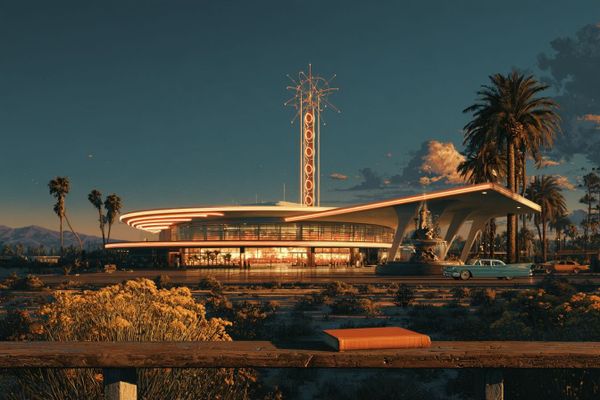
- 1939. At the New York World's Fair, General Motors' Futurama showed millions of Americans a nation of superhighways nearly two decades before Congress funded one. DuPont introduced nylon stockings; Westinghouse introduced a talking robot.
- 1950s. GM's traveling Motorama toured concept cars and a Frigidaire "kitchen of tomorrow." Disneyland opened in 1955, and Monsanto built a plastic House of the Future in Tomorrowland.
- 1960s. U.S. Steel commissioned Syd Mead to paint a glamorous future made from steel. The sales catalog, Concepts (1961), became a sensation in design schools. At the 1964 World's Fair, Bell showed the Picturephone and GE presented Disney's Carousel of Progress.
- 1980s. EPCOT opened in 1982 as a permanent world's fair of corporate pavilions: the Bell System's Spaceship Earth, GM's World of Motion and, a year later, GE's Horizons.
- 1990s. In 1993, AT&T's "You Will" campaign promised e-books, in-car navigation and video calls. It reads now like a farewell. A few years later, search arrived.
The methods made things new things possible; the spectacles made people want them.
Mining demand vs. making demand
In 2000, Google launched AdWords, and soon advertisers paid only when someone clicked. I was at Google in those early years, and one of my talking points with clients was the old line usually attributed to John Wanamaker: half the money we spend on advertising is wasted; the trouble is we don’t know which half. Search advertising provided the answer. A pitch caught on among our sellers: Don’t buy all the ads. Just the profitable ones.
I didn't realize it at the time, but that innovation marked the beginning of an epoch. Before search, demand had to be made. Firms built awareness, and earned consideration by persuasion. After AdWords, the emphasis on persuasion fell away. Demand could be found, latent or explicit, and converted at the point of sale. Because reach was global and transactions programmatic, if a customer was unpersuaded, advertisers could just move onto the next target. More like mining for gems than cultivating a garden.
It works. I know because I saw it work one campaign after another.
But in the aggregate and over time, it is a poor way to make happy customers, and a poor way to grow. Mining leaves customers feeling used. And harvesting demand does nothing to inspire new ideas. Les Binet and Peter Field, studying hundreds of campaigns in the IPA's effectiveness databank, found that brand-building drives long-term growth while activation mostly drives short-term sales, and that the campaigns in that databank have tilted toward activation anyway. Cory Doctorow gave us the word for what happens to customers when capture runs its course: Enshittification.
Even our transformations turned toward capture. Omnichannel, the retail program of the 2010s, rebuilt firms to meet demand wherever it surfaced. AI transformation today is extractive in the extreme. The appetite for a more wholesome kind corporate change is slowing down. Digital transformation reached 32% of companies by 2017, by Bain's count, less than half of TQM's peak. The rings have narrowed.
Entrenched, not renewing
In PwC's survey of CEOs published in January 2025, 42% said their company would not be viable in a decade on its current path. The same survey found that only 7% of revenue over the previous five years came from distinct new businesses. This year's survey shows where the focus lies: CEOs allocate 47% of their time to matters with horizons under a year, and 16% to horizons of five years or more.
You might expect firms like that to be swept into the dustbin of history. Mostly, they aren't. Researchers at Boston University found that since about 2000, industry leaders have become less likely to be displaced. Capture protects the firms that do the capturing. The castle walls have never been higher.
This is the corporate version of the Hedonic Treadmill. Incentives and constraints have formed an unhealthy stasis. Why go to the trouble of persuasion and invention when latent demand waits to be mined? Why risk something new and inchoate, when an old process comes with near-perfect information? The consumer works more to earn more to buy more. The firm digs a hole that always yields just enough to put change off until tomorrow. Everyone's living in Groundhog Day.
But there is a sad logic to it. Each choice is rational for the individual firm. The people making them are often very good at their jobs. The trouble is the system they serve. Over the coming weeks we'll deconstruct why the prevailing business environment rewards Manufactured Dependence, why the data we manage by favors the short term, and why the capital that funds invention is tuned for a different era.
 Christian Rishel

Data is plentiful and definitive about the past and structurally equivocal about the future. Leaders are judged on what they've delivered, not on what is coming. So decisions drift toward the light, like the man in the old joke who searches for his lost keys under the streetlamp.
The shock that never comes
Look again at the waves, and a pattern emerges. Each began when a leading firm discerned the liminal moment and made a balanced risk decision.
The pioneers of the circular economy anticipated a set of circumstances that has not come to pass. They expected scarcity to supply the impetus for change: rising commodity prices would make the case, and firms would follow the signal. That signal scarcely registered. Today's commerce is just to good at navigating supply shocks.
Many circularity-minded firms are still waiting, now for extended producer responsibility (EPR) rules. Waiting rewards passivity. The implicit hope is for a broad-based shock that affects all players equally. Meanwhile, time is the scarce resource.
 Christian Rishel
Toyota did not wait. Ohno built his system through the 1950s and '60s, based on a theory of success that targeted waste. The dividends began with the 1973 oil crisis, an event unforeseeable at the time the Toyota Production System was implemented, but in hindsight was inevitable.
That kind of decision is evident at the start of every wave. A leading firm discerns the liminal moment, when the old pattern is weakening and the new one isn't yet obvious. It prices the near-term costs of acting against the long-term costs of not acting, and it looks beyond the dashboard of today's metrics. Risk is the price of moving first. First-mover advantage is the return. Today that return is theoretical, as it was for Ohno's Toyota.
Behind every step change lies a first mover's theory of success.
There may be signs of a shift. Last week, Tesla unveiled a Roadster that flew briefly on cold-gas thrusters. Skeptics called it a stunt, and Tesla's CEO doubts it will contribute much to revenue (if in fact it ever comes to market). Still, it was the rare recent reveal that appeals to the imagination of tomorrow's customer, not just the appetite of today's consumer.
Whatever you think of Tesla, its leadership or the stunt itself, you have to admit the demonstration was fun. And I think that's what people are missing: the Circular Century will be as fun as we choose to make it.
The takeaway
Change ebbs and flows, and history records the results. The wide rings are made by firms that read the moment and move first. The cost of acting is easy to see. The cost of waiting, not as much. It takes leadership — and imagination — to look for the keys where the light isn't shining.
Next week: The Why and How of Change.
💬 Discuss: mention @christian@circudyne.com on Mastodon
Below the line are practitioner insights reserved for Dynamo members — the people building plenty with us. If you're reading as a guest, you're welcome here. But the best seats are saved for the builders. Join the Dynamos