
The Innovator's Dilemma
Clayton Christensen’s iconic analysis reveals why well-run companies at the peak of their powers are routinely vulnerable to disruption. We examine his thesis through the lens of circularity disruption.


Regular readers of this letter will be familiar with the name Clayton Christensen. He has been mentioned here 23 times, more than almost anybody else. There are two reasons for his prominence. First, his various theories are critical enablers for our circularity transformation architecture. But perhaps more importantly, his insight helps make sense of a world that is growing ever more complex and stupefying.
The Innovator’s Dilemma came out the year I started business school. It was more than required reading: it was what everyone was reading. It entered our collective bloodstream. But strong as that memory remains, a stronger one is a lecture of his at a conference a couple of decades later.
 Clayton M. Christensen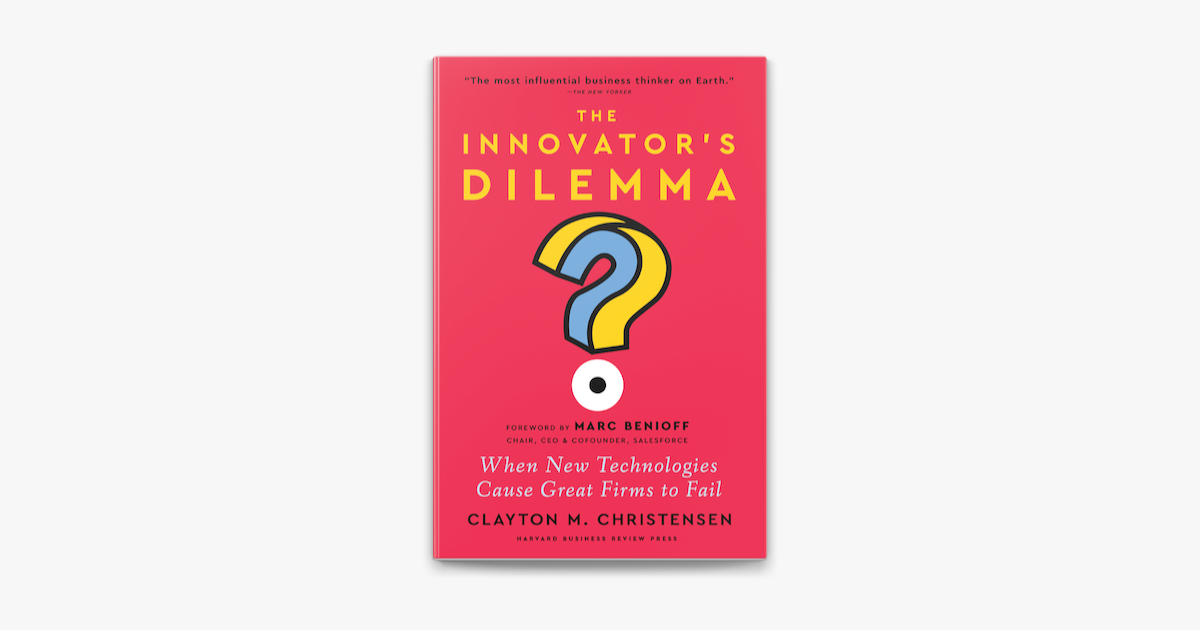
Still recovering from a stroke, he gave the lecture sitting down. His voice was subdued and he sometimes struggled to find the right word. It was a powerful moment. I came away from the experience quite in awe, because even though the messenger was weak, the message was strong.
Its striking theme: bad management doesn’t kill great companies. Good management in the wrong circumstances does.
The book in brief
To define the circumstances, Christensen distinguishes sustaining technology from disruptive.
A sustaining technology improves a product along the dimensions that current customers already value. It is serious work, in a known direction. Established firms win these contests almost every time.
A disruptive technology performs worse on the usual scale. It may be cheaper, smaller, simpler, or more convenient, and its market is unknown. But it contains the seed of new growth, and a small number of unusual customers value it at the start. Established firms lose these contests almost every time.
The disruptive innovation scenario is Christensen’s area of interest. An established firm sits inside what he calls a value network: the system of suppliers, customers, and end users the firm operates within. It sets expectations on product qualities and profit margins.
That inflects the firm’s perspective. A proposal that serves the existing value network tends to look sensible. A proposal that serves a different one looks risky at best. The firm does not reject a disruptive proposal because the firm is foolish. The firm rejects it if it violates the firm's theory of success.
Market and technology measures
Re-reading Innovator’s Dilemma after almost thirty years resolved a mistake I’ve been making about innovation strategy theory. Before this week I treated "radical" and "disruptive" as synonymous. They are not that. They come from two different theories and measure two different things.
According to Christensen (and my friend Professor Raja Roy), Rebecca Henderson and Kim Clark’s theory classifies technology. An innovation is incremental or radical depending on how far it departs from what came before.
Christensen’s theory classifies the market. An innovation is sustaining or disruptive depending on whether it serves the existing value network or a new one.
The two measures are independent. Put them on separate axes and you get four categories.
- Incremental and sustaining. Routine improvement. The next model year. Established firms win.
- Radical and sustaining. A step change in technology that serves the existing value network. Established firms also win here. Gasoline power replaced steam power in excavators. 23 of the 25 largest steam shovel manufacturers survived the transition.
- Incremental and disruptive. Simple technology and a new value network. This is where established firms die. Hydraulic excavators used off-the-shelf parts. Minimills melted scrap.
- Radical and disruptive. Both at once. This is difficult for everybody.
I have two somewhat provocative examples.
Ford's universal EV platform is radical and disruptive. Its “assembly tree” production process is a step change. The downmarket, car-like Fathom truck built on the platform also implies different customers, a different cost structure, and a different definition of the product. Developed by a skunkworks. Christensen refers to this approach as matching the size of the organization to the size of the market.
In the way that most large organizations are deploying them, frontier AI models are radical and sustaining — not disruptive. The technology is a step change. The deployment is not. There is no hesitation by established firms to invest in the technology to serve existing customers in familiar use cases. That’s how you know it’s sustaining.
It does not mean that artificial intelligence cannot be disruptive: local models promise to offer acceptable performance for an underserved market as frontier models overshoot on performance — a hallmark of vulnerable established firms.
Where circularity sits
Now let’s apply the matrix to circularity transformation. The average circularity play these days is usually incremental and disruptive. That is a dangerous category for established firms, the worst of both worlds: marginal benefit, high risk.
Consider what a circular business model requires. Repair, remanufacturing, and the sale of performance instead of product are not step changes in technology. The engineering is well understood in most cases.
The value network is the problem. A circular model serves partly different customers. It earns revenue on a different timeframe. It accepts margins the established firm has adapted to refuse. It measures success against priorities the established firm does not value and finds hard to measure.
So the established firm looks at circularity and sees a bad investment. It’s not wrong. The assessment is correct inside its value network.
This is what I really value about Christensen. He found a way to remove blame from the diagnosis. The client who declines a circular proposal is not a cynic and is not asleep. The client is applying sound management to a situation where sound management gives the wrong answer, at least as circularity’s benefits are concerned.
The three questions
In the summary of his second chapter, Christensen gives us a test to determine an innovation’s category.
- Will the value network the firm already serves value the performance attributes of this innovation?
- Must other value networks be addressed or a new one created for the innovation to produce value?
- Will the market trajectory and the technology trajectory eventually intersect?
Let’s measure circularity against these questions candidly.
The answer to the first is usually no. This goes to the heart of the say-do gap. Consequently, the answer to the second is usually yes; a new value network is required. The answer to the third depends on regulation, material cost, and demand rather than on engineering. As long as this is unknown, it breaks the tie on the other two. And because it is unknowable (as the answer lies in the future except in the case of compulsory regulation), it is usually determinative.
We have our work cut out for us. We have to map the circular value network archetypes. We have to chart new archetypes a practitioner could apply. We have to imagine a breed of new solutions that are good enough today to accelerate the transition to circularity tomorrow.
The way forward
For established firms intent on circularity transformation, Christensen’s best prescription is a change of organization. You cannot win this fight inside the established organization. The resource allocation process will defeat you. It is designed to kill proposals that current customers do not want and it performs that function well. (A former colleague and co-founder called this “the immune response.”)
The remedy is the skunkworks. Build a separate unit sized to the market it serves. Christensen's rules are:
- Give the project to an organization whose customers need the innovation. Resources then flow toward it without a fight.
- Make the organization small enough to be excited by small wins.
- Plan to fail early and cheaply. Treat the first attempts as learning and not as execution.
- Use the technology as it is. Do not hold it in the laboratory until it satisfies the mainstream market.
The most colorful example of this approach in the book was Quantum. It financed a separate company to build the next category of product, kept 80 percent ownership, and housed it offsite. When it succeeded, the parent company replaced its leadership with the skunkworks’.
Patient for growth, impatient for profit
A new circular venture should be required to become profitable quickly at small scale. It should not be required to become large quickly.
That's the antithesis of the value network of venture capital. Risk capital prioritizes growth. A venture-backed entrant is patient for profit and impatient for growth. That approach is correct for a fund that needs one holding in twenty to return the whole portfolio. It is wrong for a circular venture inside an established firm.
(This is another indicator that frontier AI models are not disruptive in Christensen's sense of the word.)
I recall a line from Christensen’s lecture, which went something like: “the established firm has a brand, a process, a value network, and capital. The only thing an entrant has is a clean sheet of paper. And that’s usually enough to beat the established firm.”
The trick is enforcing that clean sheet of paper, and sizing the skunkworks organization such that it will thrive by serving an emerging market.
What Clayton Christensen means to me
Christensen’s lecture at the conference was followed by Scott Galloway, who was in a particularly rock-and-roll mood that day. In the feedback to the conference organizer, I remember writing, “I feel like I just saw a double billing of Mr. Rogers and the Sex Pistols.”
I think the similarity between Fred Rogers and Clay Christensen has only grown for me since then. They both taught us to see what’s right with the world, and how to make us make our way through it without losing our sense of wonder.
Like every other epochal socioeconomic shift, the Circular Century requires disruption. The old world must make way for the new. The Innovator’s Dilemma is not just a strategy compass. It’s a moral one too.