Possibility of Change
Most leaders know their company must change. But there is not a lot of change happening. Before asking how circularity transformation works, we ask whether it can happen at all.


Last week I closed Summer Reading 2026 with a promise: this new season of the Letter would examine the nature of transformation itself. I meant the anatomy of the process: what do Lean, Six Sigma, Agile, and their cousins have in common? As their successor, what would circularity need to emulate? We'll get there.
But a few days of thinking about it have led somewhere more basic. Before asking how circularity transformation works, it seems fair to ask whether it can happen at all. Are firms, as presently constructed, capable of change on a scale circularity requires?
The answer is a conditional yes. This season, we'll explore the conditions.
The spirit is willing
Every year PwC asks thousands of chief executives how they see the road ahead. It poses an incisive recurring question: if your company continues on its current path, how long will it remain economically viable? In the 2025 summary (the last time they publicly disclosed the response to that question), 42 percent said ten years or less.
That is a remarkable statistic. And it is more than idle worry. In the same survey, nearly two-thirds of CEOs said they had taken at least one significant step in the past five years to change how their company makes money. Yet new businesses accounted for only about 7 percent of revenue over that span. The intent is there. The results are lacking.
The 2026 survey, fielded last fall among 4,454 CEOs, shows a differential focus. On average, CEOs spend 47 percent of their calendar on matters that resolve within a year, and 16 percent on matters five years out or more. In a finding PwC itself calls counterintuitive, the CEOs most worried about their company's long-term viability spend more time than their peers on the short term.
The question that concerns CEOs most, by a clear margin, is whether they are transforming fast enough to keep up with technology, including AI. Only three in ten say their company tests new ideas rapidly with customers. PwC titled the closing section of its report "Dynamism or denial?"
These CEOs are not fools. Last summer, citing the logic of Clayton Christensen, I argued that incumbents usually stumble while doing exactly what they were built to do, and doing it well. Next quarter's KPIs set the rhythm of what passes for good management these days.
 Christian Rishel
The urgent crowds out the important, and the habit is self-reinforcing.
Seeing red from the other side of the counter
If leaders are stuck, their customers are restless. They have been for a while.
 Christian Rishel
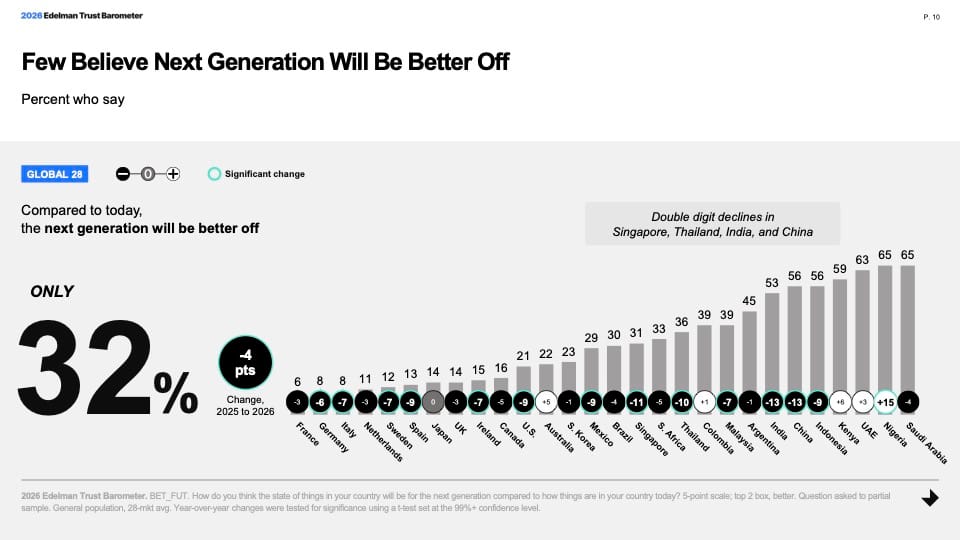
A year ago, in A Future To Look Forward To, I listed the anxieties of the moment. The first was a question: will our children be better off than us? The 2026 Edelman Trust Barometer has since given an answer. Across 28 countries, 32 percent say yes, down four points in a year. In France and Germany it is fewer than one in ten; in the United States, about one in five. Contentment follows progress, and most wealthy countries no longer believe they are making any. An exception is Australia, where the figure rose five points. Australia also has one of the densest fleets of rooftop solar on earth. Keep that in mind later in the season when we get to the catalysts of change.
Underneath the numbers is something more specific. Whole segments of customers have changed what they need, what they like, and what they want, and the brands they depend on have not kept up.
What they want has been moving toward enough: the precise amount that satisfies without burdening. Luxury has begun to mean joy, craft, and fit rather than scarcity. People sense the care nobody was supposed to see, as Walt Disney understood decades ago. And they notice its absence just as quickly: many serve themselves when institutions like brands and governments offer chaos instead of value.
 Christian Rishel
 Christian Rishel
 Christian Rishel
What they get instead is manufactured dependence. A firm that has lost the capacity to serve its customers manufactures reasons for them to stay. On platforms the same decay has a less polite name. When customers balk at a worse deal, the say-do gap gets blamed on them. More often the firm has lost the imagination to make what they asked for.
So customers leave, quietly. They make their old stuff last. There is no boycott and no angry letter. These conscious non-consumers don't register on anyone's dashboard, because demand models work like a metal detector: very good at finding what's there, and unable to discern what's walked away. Two-thirds of the CEOs in PwC's survey reported trust concerns last year. They can see the customers who complain. They can't see the ones who left.
Douglas Holt would recognize this as a myth market, and a wide-open one at that. The mythology gap, the distance between how people live and how they want to live, is wide, and very few brands are telling a story that closes it. Gaps like this do not stay open for long. In Holt's history, the brands that became icons were the ones that sided with the counterculture first. Someone will fill this one. The rebels are already making a New Deal for themselves. What they lack are allies.
 Christian Rishel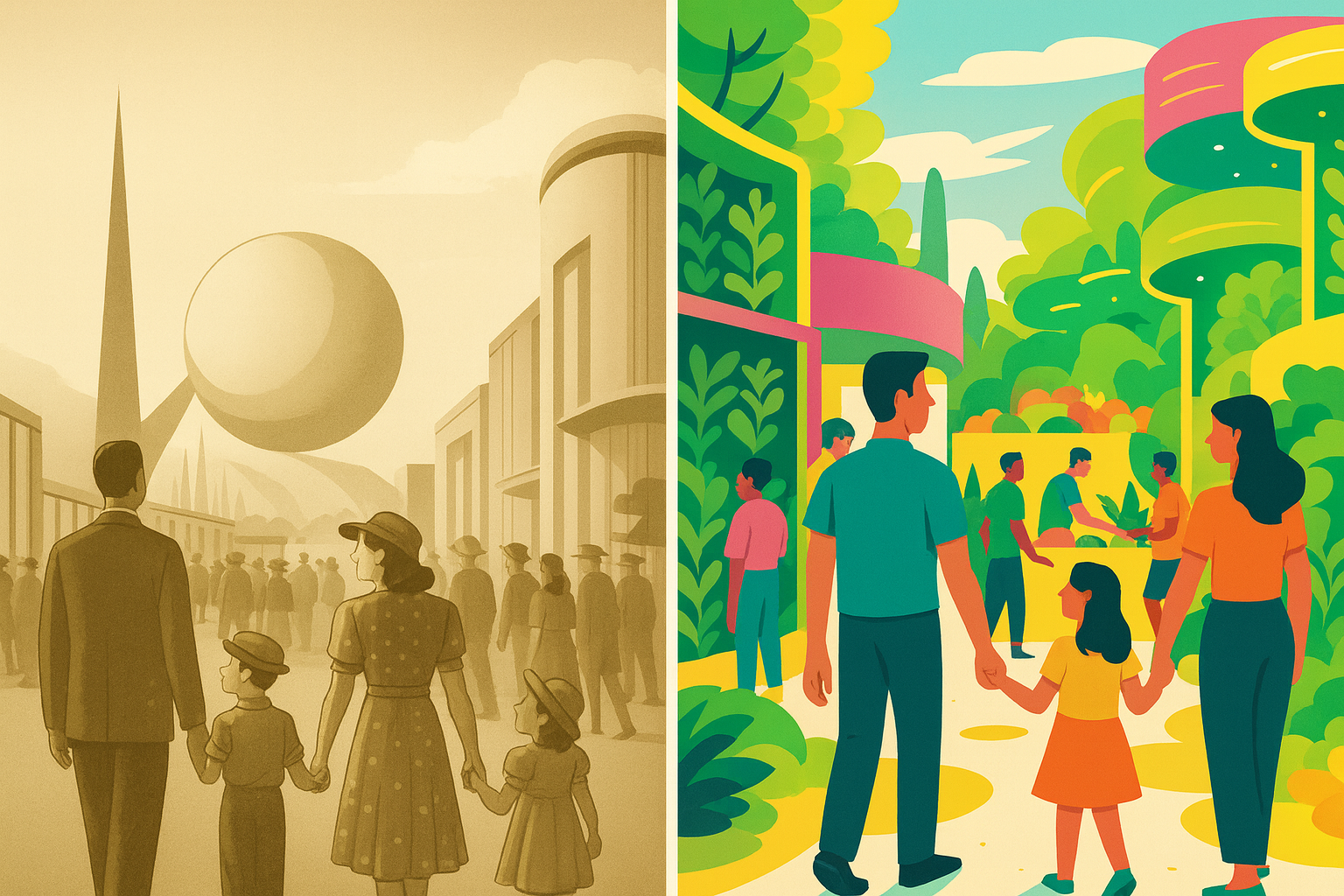
 Christian Rishel
 Christian Rishel
An evergreen example
So is change possible? The best evidence I know comes from the example of Lean, which started off as the Toyota Production System.
 Christian Rishel
In his account, Taiichi Ohno recalls that before the oil crisis of 1973, when it came to industry's position towards Toyota's methods, he "found little interest." Inside the company, the system was already mature. Kanban had been proliferating for years. But hardly anyone outside it cared.
Then the oil embargo hit. By 1974 Japan's economy had fallen to zero growth, and many automobile companies were suffering. But Toyota's fortunes were on the upswing. Suddenly everyone wanted to know its secret.
There are two lessons to draw from that history. The first is hopeful: change from inside an incumbent is possible. Ohno was an executive at a family-controlled company that was about as establishment as it gets. And he changed the game anyway. The second is sobering: the remedy everyone needed waited years to be adopted. The oil embargo provided the needed motivation to drive the system's interest, but the underlying value was always there.
Circularity's situation resembles Lean's in those pre-1974 years. The value is there to be captured, but the imperative to apply it does not line up with the incentive and permission structures of the people who could use it best.
This season we will focus on closing that gap: how a company comes to embrace the change without waiting for the forcing function.
Possibilities for change
The season follows three lines of inquiry.
- Is change possible within existing firms to the degree circularity requires? We will take inventory of the great transformations of the last century — Lean, Total Quality, Six Sigma, Agile, and some you may have forgotten, like Y2K and omnichannel — and ask what made the durable ones last.
- What drives it? My bet is that the push comes from below, from customers who have quietly started repairing, keeping, and non-consuming. Our institutions that once promised order now produce chaos. That is the casus belli of today's counterculture.
- What catalyzes it? Here we return to the Three Dynamos — distributed power, ambient intelligence, and recombinant matter — the bill of materials for the Circular Century.
Ohno began at the end of the line and worked backward, letting each process pull what it needed from the one before it. In time the pull reached all the way to the dealer's showroom. This season starts at the end too: at the Last Moment of Truth, the moment a product's first life ends and something must happen next.
It is the moment the customer knows the product best. It is where a product either goes on to another life or simply stops. And it is the only place a claim of circularity can be checked.
The takeaway
Most leaders already know they must change. This season asks what it takes for a company to actually do it. The best answer we have says to start at the end.
Below the line are practitioner insights reserved for Dynamo members — the people building plenty with us. If you're reading as a guest, you're welcome here. But the best seats are saved for the builders. Join the Dynamos