Personal Mobility
The right vehicle for every trip, owned by no one in particular — how the Circular Century unbundles mobility from the car in the driveway.

This letter is part of the Carousel of Plenty, a series exploring products and services that could only exist in the Circular Century. We talk a lot about circular transformation — why it matters, how it works, what it demands of leaders. This season, we show you where it leads. Each letter presents one solution: something you'd use, live with, or depend on in a world designed for permanence rather than disposal. The premise is simple. The linear economy promised progress and delivered volume — more things, fewer of them worth having. The Circular Century delivers plenty: the precise amount that satisfies without burdening. These are its furnishings.
Turn Sunshine into Freedom. And Fun.
Friends, let me tell you about the recipe for turning sunshine into freedom — and fun.
At our house, it starts with panels in the yard. That sunshine — free every morning, never late for the job. Part of that energy goes to a battery. The rest, to a sleek box out back, no bigger than a deep freezer, that drinks the light in and holds onto it. And out of that box comes what we need to carry us through the day and then some.
The sleek box makes the hydrogen that fills up our converted old truck. That truck is more than a dependable old friend. It is a symbol of freedom. Fueling it up requires no station, no pipeline, no bill from anybody downtown. That's my conveyance of choice.
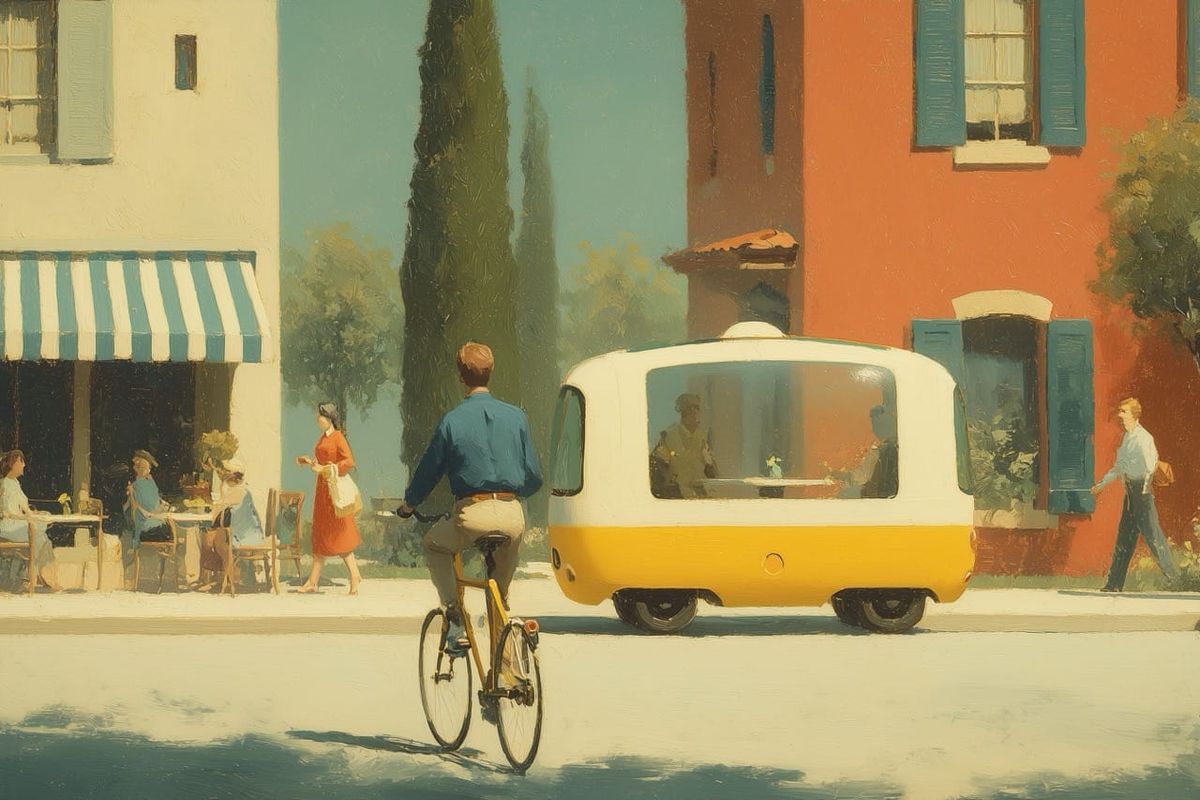
The boy prefers his bicycle. It charges on the porch rail overnight and runs him to school in the cool of the morning. And when Marie has to get clear across town, she taps the glass by the door and a tidy little car comes round the corner, just the right size for the errand, carries her there, and goes on about its business. She doesn't park it. She doesn't own it. She just goes.
Time was, a family needed one big machine to do every last thing, and paid for the whole of it whether it moved or sat. Now we keep the right thing for each thing, and we run it all on light we caught ourselves.
And the wonder of it is the whole street's at it now. Every roof a little powerhouse. When the lights flicker over in the next county, ours stay lit — because the power is ours, made at home, and shared right down the row.
We gave up nothing we loved to get a cleaner, quieter day. We just stopped renting our freedom by the gallon.
Now — that's progress.
For the Consumer
Consider ketchup.
For most of the last century it stood alone on the American table. It was the necessary and sufficient condiment because it complemented the same small flight of dishes that most people ate all the time. One red bottle could sit at every elbow and do the whole job. Then the table opened up. A country that once argued over a single condiment learned to cook a hundred cuisines, and to stock its shelves with herbs and grains and peppers to satisfy a more sophisticated palate. The strange and happy result is that we eat better now and enjoy it far more. Now we reach for the ripe avocado or the bowl of pho because it tastes good. The health came along for the ride.
Cars are like ketchup.
For a hundred years, one machine had to be and do everything. The school run and the cross-country haul. The trip for a loaf of bread and the long drive home at the holidays. So each of us bought, and built lives and a society around, the machine that could manage our hardest, rarest day — five seats, a big motor, room for the lumber — and then drove it empty and oversized through all the ordinary ones. A compromise, repeated countless times.
There is a reason that machine kept growing. The car has carried us, thrilled us, and set us free, and no one is taking that away from it. But look at why it weighs what it weighs. It moves by burning, and burning is a violent business, so the machine has to be heavy enough to contain the violence and armored enough to survive it. Armored, it feels safe, so we drive it faster. Faster, it grows heavier still. Heavier, it grows more dangerous — to the people inside it and everyone outside it — so it calls for more armor. Round and round the spiral goes. The hulking shape of the thing in the driveway is the shape of that spiral, drawn in steel.
The waste is not where you think it is. We have always assumed the harm a car does is in the driving. Some of it is; much of it is not. By the time a new car reaches the driveway — before it has rolled a single mile — it has already done close to half the environmental damage it will ever do, in the mining and the smelting and the making. The environmental impact is cash on the barrelhead in more ways than one. Which turns the whole matter over. The real waste is not the motion. It is the stillness.
And these machines are almost always still. The typical car sits parked about ninety-two percent of its life. When it does move, it carries one and a half people in five seats and turns barely a tenth of its fuel into forward motion — the rest lost to heat and to hauling its own dead weight, some twelve pounds of machine for every pound of person aboard. To keep all of this standing ready, we have given over half the land of the modern city to roads and parking. And the toll in lives we agreed, long ago, to stop seeing. A thing that does its damage at the start and then sits idle is the most wasteful arrangement we could have made. The only way to redeem the harm already spent is to use the thing hard and keep it long. A parked car redeems nothing.
We couldn't have done better before. Now we can. The car was never really chosen so much as forced — the only sensible answer in a world where summoning the right ride was impossible, where fuel came by the tankful from far away, and where a worn-out vehicle had nowhere to go but the crusher. Three things have changed, quietly and at once. We can now call the right vehicle to the right trip about as easily as we once turned a key. We can make and keep our own power. And we can build a machine to come apart and go round again. Put those together and the one compromise machine breaks into a whole table of them — the right size for each trip, summoned and surrendered, sometimes owned by no one in particular.
We have seen both of these futures drawn before. At the 1939 World's Fair, the most beloved thing in it was a vast model of an America remade for the car — every need answered by more highway and more horsepower. We built that one, more or less, and got the sprawl and the spiral along with it. A generation later a different man sketched a different city: one where each kind of movement had its own proper place, and the street was handed back to the people walking it. We never built that one. We can build it now.
And in places, we have started. Paris has been determinedly taking the curb back from cars and giving it to café tables, trees, and room to stroll. The Dutch decided several oil crises ago (who's counting?) that getting around should mean choosing easily among trains and bikes and your own two feet, and laid out their towns to make it work. In New York, the companies that make deliveries are swapping double-parked vans for pedal carts that thread the same streets faster. None of this waited for permission. It is the walkable block of The Neighbors and the home-made power of Energy Sovereignty arriving on the street as ways to move.
And out at the far edge of it is the thing the fellow on the porch was getting at: a family making its own fuel from its own roof, beholden to no oil company, no utility, no carmaker — the whole stack of it unbundled, right down to the light that turns the wheels.
For most of a century we were told to choose: freedom or thrift, the open road or the light footprint. The unbundled world hands you the whole table and asks you to give up none of it. Freedom, lightness, and fit, all at once. In the Circular Century, we will have it all.
We know how to outgrow ketchup. We'll do it again.
By the Producer
Begin with the question every carmaker is asking in the face of evolving demand patterns: if people stop buying cars the way they buy them now, where does the money go?
Let's return to Roger Martin's provocation that strategy starts not with what to do next but with what winning would even look like. For the automaker, winning has always meant moving more metal off the lot — more units, more model years, more reasons to trade up. For the company that builds the unbundled world, winning looks like something the old firm is not designed for: to be the one people trust to move them, for a lifetime, across whatever machine the moment calls for. The carmaker wants to sell you your next car. The new firm wants to be the last mobility company you ever need.
Where to play follows from that. You do not fight for the crowded center — the driveway, the new-car smell, the trade-in. The opening lies where the car is weakest. Horace Dediu, who named micromobility and titled its manifesto The Car Will Be Unbundled, spent years hunting for a way the car might be disrupted and could not find one: cheaper cars fail against the used-car lot, and electric drive and self-driving only make the incumbent stronger. Then he rode an electric bike, and had his answer in twenty minutes. The disruption was never a better car. It was the short trip the car has always handled worst — the two-mile errand, miserable with parking and cold starts — served by a machine built for purpose.
How you win is the part that has waited for the right machines. The private car sits inside a dense web — financed, insured, registered, taxed, fueled, serviced, regulated — and the whole web exists to move it off a lot and keep it running. The new modes fit almost none of it. Recall the law of conservation of attractive profits from Clayton Christensen via Ben Thompson: when the profit drains out of one link as it commoditizes, it reappears at the next link, captured by whoever integrates around the customer. As the car itself becomes a commodity, the profit migrates — to whoever orchestrates the whole portfolio around your trip, and to whoever owns the fleet and sells you the outcome instead of the object.
A second move is to migrate the half-century-old performance economy paradigm from B2B to B2C. Recall Rolls-Royce stopped selling jet engines to airlines and started selling flight-hours: the airline buys the thrust, Rolls-Royce keeps the engine and every repair bill. Incentives align this way around better products and higher performance. When a maker keeps the asset, durability turns from an opportunity cost into a profit, and building something to wear out becomes self-sabotage. Point that same move at the driveway and you get a company like Hugo Spowers's Riversimple, which does not sell you a car at all — it keeps the car for its whole life and sells you the miles, so that every breakdown and every drop of fuel is the maker's problem to manage rather than yours, with the natural world written into the company's own charter as a stakeholder with a seat at the table.
There is an implicit repair buried in this. Today a car is designed, priced, and sold to its first owner, though it is built well enough to outlast that owner two or three times over — and, at the same time, nowhere near as well as it could be. Compare an airliner: refit on a schedule, maintained to documented standards, its whole decades-long life planned from the drawing board, because the people who built it have their money riding on every year it stays in service. A car gets none of that care, because the maker's interest ends at the sale. Keep the asset, and the second owner stops being an afterthought and becomes a customer worth designing for — and the car is finally engineered like the durable, maintained, decades-long machine it has always physically been.
Some incumbents can see the shape of it. BMW's i Vision Circular, a concept the company showed in 2021, was drawn from a blank sheet to come apart: a single clever fastener, etched with the word circular, that frees a wheel or a seat with one turn of a tool; almost no glue, no paint, no chrome, no leather; a body of recycled aluminum and a battery built to be melted down into the next one. It keeps itself current through software and "options as a service" rather than the trade-in, and when it is parked it can feed power back to the house and the grid. It is a beautiful piece of thinking. It is also the right design still wearing the old business model — because all that lovely disassembly only pays the company that builds the car if that company is also the one that keeps it. The design is ready. The model is the leap.
Most of what gets sold as the future of driving is not. Cheaper cars, electric drivetrains, even the self-driving car — each one makes the existing car better and the existing carmaker stronger. The driverless car has a real place at this table; think of it as the descendant of the old monorail, the smooth automatic shuttle, now loosed from its track and folded into the mix as one mode among many. But a company that bets everything on "the same car, now without a driver" has made the safe wager and dressed it up as a bold one.
And it is not only the carmakers who should be uneasy. The change reaches the whole apparatus that privileges the car — the road engineers, the parking minimums, the fuel taxes, the agencies whose every habit assumes a world of private automobiles. They are incumbents too. They will be moved.
There is a pattern in which brands survive a shift like this one. The ones that endure join the counterculture rising against the old order rather than defend it. We wrote, in Are You a Punk?, about the quiet rebellion of people building lives that no longer depend on systems that have stopped serving them — the menders, the growers, the ones making their own power. A mobility company crosses over to them not with an advertisement about freedom but by handing them the real article: a way to move whose terms they own. And the reward for crossing over compounds. A household carried for thirty years is worth more than any showroom sale could ring up — not a row of transactions but a long, rising curve, captured whole by the company that owns the life of the machine and the trust of the person it carries.
The rest of this letter is for Dynamo members — the people building plenty with us. If you're reading as a guest, you're welcome here. But the best seats on the Carousel are reserved. Join the Dynamos.