The Circular Century — So What
Clarke said that whether or not we are alone in the universe, the prospect is terrifying. This season's final letter asks what would make us worthy of the answer.

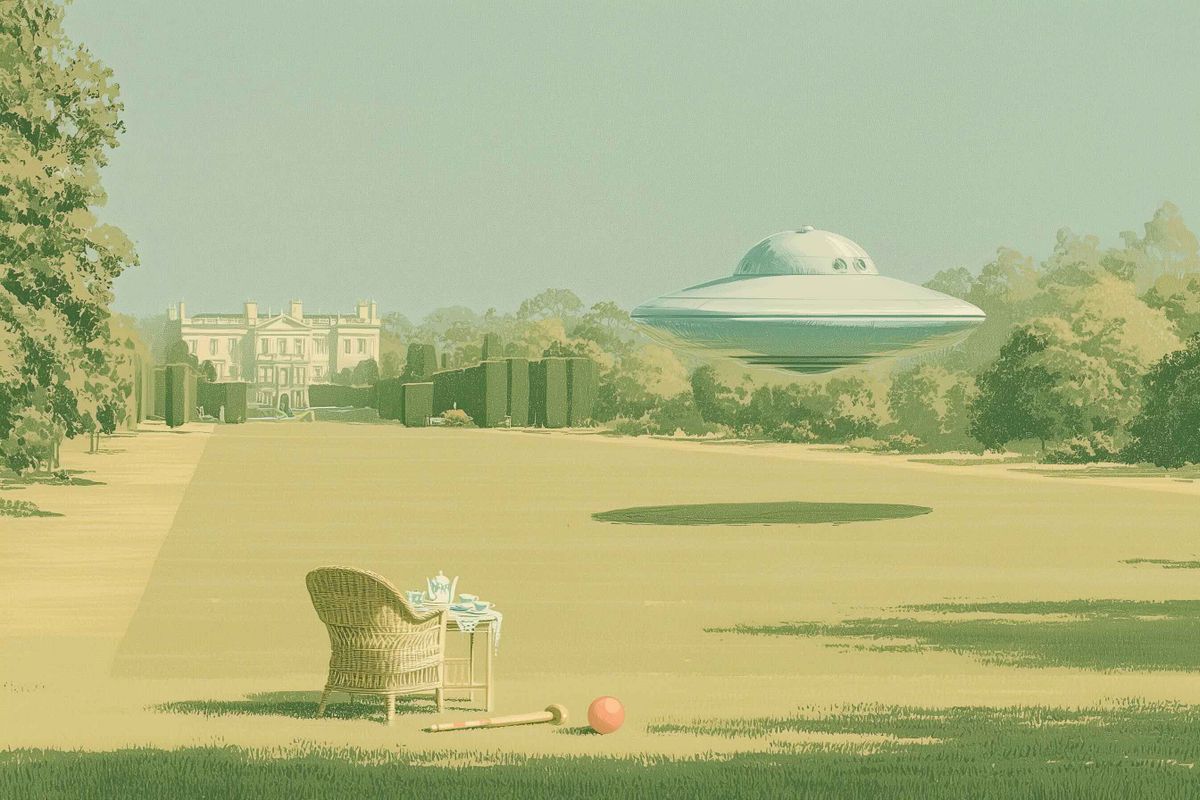
This letter is part of the Carousel of Plenty, a series exploring products and services that could only exist in the Circular Century. All season we have shown you its furnishings — one solution at a time, things you'd use, live with, or depend on in a world built for permanence rather than disposal. These last two letters set the catalog down and step back to the questions the whole season was built to reach: why this abundance is different from every one that came before it, and what, in the end, it is for. This is the conclusion.
When I was a kid, I really enjoyed reading Arthur C. Clarke. One of his observations has endured in the popular collective consciousness: "any sufficiently advanced technology is indistinguishable from magic." It's a pretty good line. Tech founders use it a lot.
But I'm fonder of a more obscure remark of his: "Either we are alone in the universe or we aren't — and either prospect is terrifying." I call it Clarke's Binary.
I like the way Clarke formulated this observation, because it disallows complacency. The moment you consider the choice, the failsafe option — indifference — falls away.
If we are alone, then we have to reckon with representing, on our own, the full potential of the entire universe. And if we are not alone, then somewhere out there is someone older and wiser, and one day we may have to account for ourselves to them.
I used to think of this as Clarke's "paradox." But it's not a paradox. It's a choice, really. And it's clever because to understand it is to be compelled by it; as there is no logical alternative, there is no procedural opt-out. That's why I've come to think of it as a binary. It's one thing, or the other.
Also, it is a set of instructions. Because whichever way it breaks, the work is the same: to make ours a civilization worthy of either answer.
This is the last letter of the Carousel of Plenty season. Its mission: to show how life in the Circular Century will feel. Better living through circularity. Hopefully, if you've been following along, it's given moments of hope, maybe aspiration.
But even if it has, there is a larger question this (or any) vision of the future has to answer: so what?
If the Circular Century is just the latest update on consumer welfare, aren't we just repeating a cycle? It can be something more, but to prove it, we need to account for it.
We need to know what the Circular Century is for.
Picturing the unimaginable
Let's go back to Clarke's idea. Suppose the reckoning actually came. Suppose, one ordinary morning, a ship set down. In the movies, it usually happens in Washington. For our purposes, let's keep it personal. Let's say the ship lands on the long lawn from last week's letter — the one going gold at the edges, the white chairs, a tennis match half-played.
The door opens. The visitors have come to see what we made of the place.
Could we walk out across that grass and meet them as neighbors? Could we stand there and answer for ourselves, without flinching?
I find I cannot really picture it. Not because it frightens me. Because it sits outside everything any of us has ever lived. We have no memory to reach for, no extraordinary moment that felt remotely like it. The mind just slides off.
So let me trade it for a reckoning we can feel.
Let's pick a different scene from a different movie. Picture a council of force ghosts, like Obi-wan Kenobi. A small group of luminaries we have lost. People many of us revered, called back for one evening to look us in the eye.
This thought experiment is easy for me. I know instantly who I'd hope to be visited by. Two groups of three. Three who loved the living world: Jane Goodall, Jacques Cousteau, Carl Sagan. And three who loved the made world: Steve Jobs, Clayton Christensen, and Peter Drucker. Wise masters all.
Here is the thing about this council. They used to be us. They walked the same ground, paid the same taxes, lost sleep over the same headlines. They are on our side; they want us to make it. So their questions would be plain, and answerable, the kind you could actually take up on a normal day. And because they are sitting together as one body, their questions would not contradict each other or leave gaps. Six people. One verdict.
We will hear from them. But first, let's consider an alternative perspective.
Part One — How we got here
There are two ways to understand something like the telos of the Circular Century. You can reason forward from where we have been. Or you can reason back from first principles. Let us do both — and see if they arrive at the same place. That is usually how you can tell a thing is true.
Start with where we have been. The clearest record of the modern economy we have is the history of the automobile.
In 1913, the finest car on earth was a Rolls-Royce. To prove how smoothly it ran, salesmen would stand a coin on its edge on the running engine, and the coin would stay put. It was a beautiful machine, and almost no one would ever have one. Rolls-Royce built a few thousand of the best cars in the world. In the same years, Henry Ford built fifteen million ordinary ones. If you had a dollar to invest in 1913, you put it on Ford, not on Rolls. Craft, perfected, reached its asymptote. By its nature it served only a few.
Now skip ahead seventy years. By the 1980s, the smart money was not on Ford anymore. It was on Toyota. Toyota had figured out how to build with Ford's scale and something close to Rolls-Royce's care, at the same time — a way of working we came to call Lean. And Lean gave the world Lexus. There was an ad: a champagne glass tower balanced on the hood of a running LS400, the wine trembling and never spilling. It was the Rolls-Royce coin trick from eighty years before — only now you could drive it home for the price of a good Buick. The circle closed. A car built in the numbers of a Ford and quality of a Rolls, with the cost structure of Toyota.
We are standing at comparable fork right now. Today's way of making things is finely honed and, like the Rolls, indiscernibly limited — it runs in a straight line from raw material to landfill, and that line has an end. The step-change is circularity: things made to come back, to be remade, to keep going. Somewhere out there, to be determined in the fullness of time, is circularity's Toyota. And whoever they turn out to be, they will be as far past where we stand today as that Lexus was past the Rolls-Royce Phantom. Industrial gave way to Lean. Linear is giving way to circularity. Call it Lean 2.0 — craft, at scale, that also lasts.
That is the production story. Two more forces sit underneath it.
The first is that we have come into sudden plenty before, and mostly we have fumbled it. Last week's letter walked through two of those windfalls — an aristocracy that mistook its luck for virtue, and a digital generation handed the whole library of the world but left anxious and scattered by the gift. Having plenty is not the same as knowing what to do with it.
The second is a choice we made once and can make again. After World War II, there was significant productive overcapacity. We had options for how to use it. The choice we made was to engineer demand to meet the overcapacity: planned obsolescence and its cousins, what I call manufactured dependence.
We taught people to want more than they needed, hired the best minds of the age to do it, and pointed the whole apparatus at manufacturing desire. Carlota Perez' analysis has identified the pattern: at the transition from one age to the next, a moment like this one, when a new set of technologies has been built and is ready to be spread, can become a golden age — if we aim it at something worth having.
So where does the new plenty actually come from? Not from making more, faster, and burning it off quicker. From three plain things working together. Power you make yourself. Intelligence woven quietly into ordinary objects. And matter that comes back around instead of going to the dump. Supply, on one side. A sense of enough, on the other, so the surplus is not simply squandered. And things made beautiful enough to be worth keeping. Put them together and the surplus is real — and for once, we get to keep it.
Part Two — What it's for
Now the other road. First principles. Let's return to our council.
It's not a trial, or a sermon, but a kind of lesson. They teach by asking questions.
Drucker speaks first. Are you anticipating the future, he asks, or making it? Are you running on yesterday's logic, or on something new?
Christensen leans in. What is the job that actually needs doing? And are you willing to disrupt yourself to do it?
Then Jobs. What is it about the world you inherited — built by people no different from you, who came before — that needs changing? And what will you build that other people can use to change it?
Now the three who loved the living world.
Cousteau, who with a friend invented the Aqua-Lung so he could breathe underwater: Are you called by the wonder of the world? What will you invent to get closer to it?
Sagan, who believed our purpose is to be the way the cosmos comes to know itself: Are you a fair witness to the universe as it actually is? And what is your part as a citizen of the pale blue dot, the only home we have ever had?
And Goodall: have you treated nature with the respect it deserves? Have you given people the hope they need?
Listen to them together and they turn out to be asking one question, posed six ways. It is a charge to lead, and to build, in service to the living world. The people who made things and the people who loved the planet are supposed to be on opposite sides. Sitting on one council, they ask for the same nice thing.
That is what the Circular Century is for — to make us feel that not only is it going to be alright, it's actually going to be pretty nice.
Most of the time, the right thing feels good — and given enough time, it turns out to be good for everyone. That is pretty much it. But it requires leadership, which is a choice. The choice that feels good in the living up to it. The choice our grandchildren will thank us for. Sovereignty, joy, and worth — they are the same plain truth expressed three ways.
Which brings us back to Clarke. If we swap two words around, his admonition lends us quite a bit more agency, and with it, responsibility: "Either we are alone in the universe or we aren't — and the prospect of either is terrifying." Being forced to face reality is hard. Reckoning with logic that deprives us of our comfortable indifference is rough. But that is the nature of progress. The alternative is worse.
Recall our council. The point wasn't about discovering whether we are alone or not. It is whether we are worthy of either possibility. A civilization that builds to last, that treats the living world with respect, that keeps faith with its children — that is a civilization worth meeting. And worth being, even if there is no one out there to meet it.
That is the moral of the story of the Carousel of Plenty.
The last word
I want to save the last word for one of the six members of our imaginary council.
Jane Goodall died last October. Before that, she sat alone with a camera and recorded what she wanted said once she could no longer say it herself. Of everyone on the council, she is the one who truly came back to speak to us — underscoring the value of it. These are people who used to be us, who wanted us to make it. She left this proof:
I would say I was somebody sent to this world to try to give people hope in dark times, because without hope, we fall into apathy and do nothing. And in the dark times that we are living in now, if people don't have hope, we're doomed. And how can we bring little children into this dark world we've created and let them be surrounded by people who've given up? So even… even if this is the end of humanity as we know it, let's fight to the very end. Let's let the children know, you know, that there is hope if they get together. And even if it becomes impossible for anybody, it's better to go on fighting to the end than just to give up and say, "Okay."
In other words, without hope we fall into apathy and do nothing — and that we owe ourselves more than that. That is the answer to the terror. Hope is what you do with clear eyes. It is how a civilization stays worthy of whatever the universe has in store.
So. The Robot Milkman, the atelier, the wardrobe, the commissary, the car.... Twelve letters, twelve possibilities. Add them up and what they bought back is time, and attention, and the freedom to become — the freedom that every age of plenty before this one rationed out to a lucky few. That is what the Circular Century is for. Not more. Better. Worthy of the cosmic answer, whichever it is.
The rest of this letter is for Dynamo members — the people building plenty with us. If you're reading as a guest, you're welcome here. But the best seats on the Carousel are reserved. Join the Dynamos.