The Commissary
What if the best place in town were the one we all went to? The Commissary is the Automat reborn — good food made special, and within everyone's reach.

This letter is part of the Carousel of Plenty, a series exploring products and services that could only exist in the Circular Century. We talk a lot about circular transformation — why it matters, how it works, what it demands of leaders. This season, we show you where it leads. Each letter presents one solution: something you'd use, live with, or depend on in a world designed for permanence rather than disposal. The premise is simple. The linear economy promised progress and delivered volume — more things, fewer of them worth having. The Circular Century delivers plenty: the precise amount that satisfies without burdening. These are its furnishings.
The Best Place in Town Is the Place We All Go.
Friends, there's a place down the street I want to tell you about.
It's a little like the old Automat, if you're old enough to remember those — the wall of small glass doors, a coin in the slot, a sandwich waiting behind the window like a present. My grandmother used to talk about hers the way other people talk about a church. But this is a new thing, and I think it's a better one.
You walk in around six and the whole neighborhood is already there. The Petersons in the corner. The young couple from the third floor, taking turns with the baby. The fellow who fixes everyone's bicycles, eating by himself and not minding one bit, because nobody stays by himself for long in a room like this. There's a counter where the food is, and it is good food — the kind you'd be proud to put on your own table, because somebody close by grew it and somebody close by cooked it.
Here's the part I love best. People don't just sit. They get up between bites and wander over to another table to say hello, to hear how the trip was, to settle who's bringing what on Sunday. A plate in one hand and the news in the other. It's a party that happens to serve supper.
And on one of those nights when you're worn through and the day was too long, you take it home in a box, and nobody thinks a thing of it. The door is always open. The coffee is always on.
That's the truth about the best place in town. It isn't the fanciest one. It's the one we all go to.
For the Consumer
There was nothing like the coffee at the Automat
Its aroma and its flavor were supreme
from a silver dolphin spout
the coffee poured right out
not to mention at the end
a little spurt of cream!
— from "(There's Nothing Like) The Coffee from the Automat", written and sung by Mel Brooks
Once, there was a restaurant where a nickel bought the best cup of coffee in the city.
It was called the Automat, and for most of the last century there were scores of them across Philadelphia and New York, feeding hundreds of thousands of people a day. You came in off the street into a room of marble and chrome and stained glass, a room built like a bank or a temple. Along one wall stood little glass doors, hundreds of them, each with a dish waiting behind it: a wedge of pie, a bowl of creamed spinach, a sandwich, a slab of cake. You dropped your coins in the slot, turned the knob, and the door swung open. You carried your plate to a table. No waiter. No tipping. No one whose job was to decide whether you belonged. The banker and the bricklayer and the young woman who had come to the city alone all ate the same fresh pie under the same colored glass. A newspaper rhyme from the thirties imagined the technocrat, the plutocrat, the autocrat, and the Democrat all laying down their quarrels to go eat together at the Automat. People called it the most democratic room in America, and they meant it.
It worked because of three quiet inventions, none of them food.
- The first was automation. The little doors and the coin slots did the work a roomful of waiters would have done, which meant the money that would have gone to serving could go to cooking instead, and the savings could come back to you.
- The second was standardization. Behind that wall of glass doors sat a central kitchen — the company called it a commissary — where the pie was made to one exacting recipe and sent out fresh to every location in the city, and the coffee was made fresh and poured out on a strict clock, long before it could turn bitter. A nickel did not buy you cheap coffee. It bought you the very same coffee, held to the very same standard, that it bought the man in the good suit two tables over.
- The third was care lavished on the whole experience: the marble, the light, the easy flow of the room. The Automat had decided that an ordinary meal, taken by an ordinary person, was worth staging like an occasion.
Put those three together and you have the wonder of the age: good food made genuinely special and genuinely cheap at the same time.
The dolphin was the part with no reason to exist.
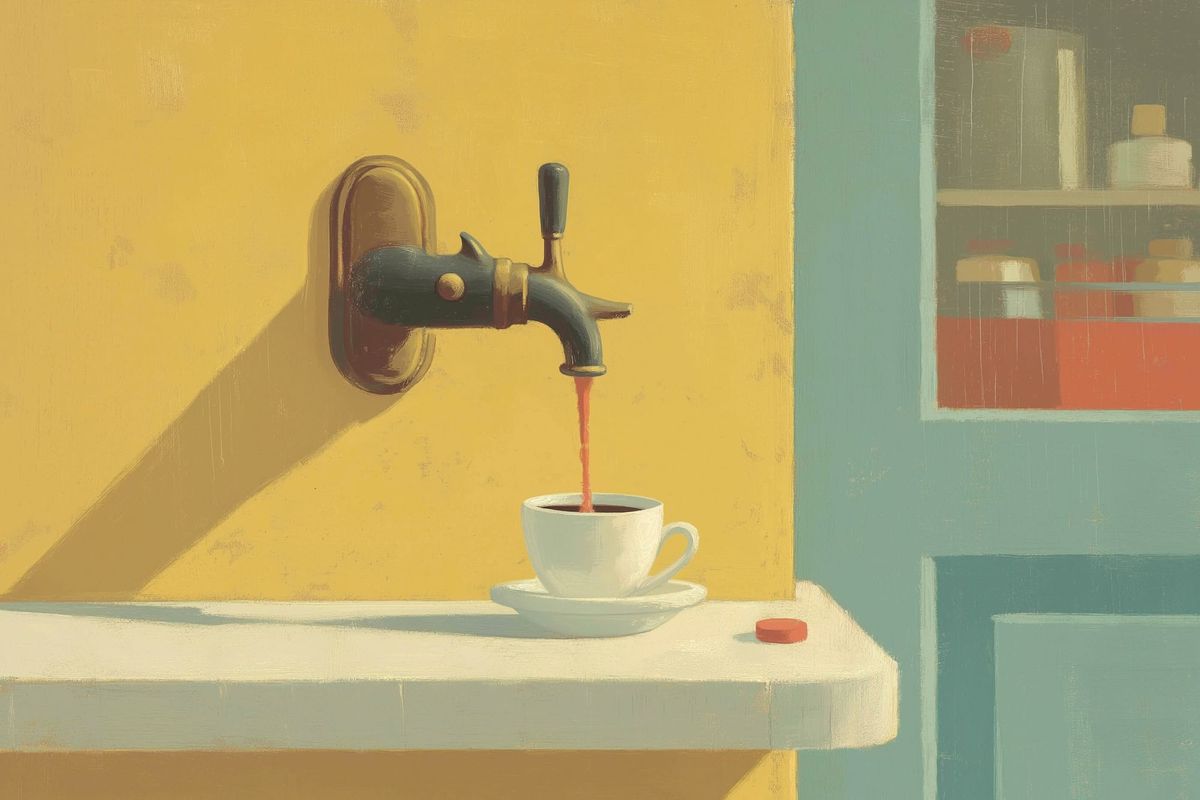
At the coffee station, the coffee did not come from a pot or a plain tap. It poured from the mouth of a dolphin — a spout of polished metal, cast and shaped into a dolphin's head, for no reason except that someone had decided the best coffee in the city deserved to dispense in a small ceremony. People remembered that dolphin for the rest of their lives. They remembered it longer and more fondly than they remembered meals at far grander places.
The success of that detail is worth thinking about, because there was no business case for it. A length of pipe would have poured the same coffee. But the people who built the Automat understood something that can't be captured in a spreadsheet: that a small, beautiful detail, met every single morning, becomes part of how a person feels about being alive. Steve Jobs's father taught him to finish the back of the cabinet — the side that faces the wall, that no buyer will ever see — because the craftsman would know it was there. The dolphin is that same lesson, turned around to face the customer. It is the back of the fence, painted, and handed to you with your coffee.
Then it died.
The nickel held for the better part of forty years. Forty years is long enough that a price stops being a price and becomes a promise.
But the coin slots had been built for nickels, and they could not take pennies. So when costs finally climbed — after the war, when everything climbed — the price of the coffee could not creep up an honest penny at a time. It had to wait, and hold, and then leap all at once to a dime. Twice the price, overnight, in the autumn of 1950. The newspaper called it a black day for coffee drinkers. People felt it as a betrayal, and they were right to. Within the year the company was pouring tens of millions fewer cups.
The very machine that had made the cheap coffee possible — the coin slot, the automation, the first of those three quiet inventions — was the thing that turned a gentle rise into a broken promise. The Automat's genius and the Automat's undoing were the same mechanism. The tools that let it hand out a nickel's worth of dignity in 1912 were the tools that could not bend in 1950.
The rest of the story happened to every Main Street in the country. Families moved to the suburbs. The car replaced the walk. A new kind of cheap food arrived, faster and thinner, sold through a window to a person who never left the driver's seat, and it answered a real need — the need to be fed in a hurry in a hurry-up world. The Automat could not answer that need without ceasing to be itself. The marble rooms emptied out. The last one closed its doors in 1991. By then the dolphins were being sold off at auction, one at a time, to people who remembered.
The Commissary is the Automat's promise, kept by better machines.
Consider what we lost when those rooms emptied — and what replaced them never gave back.
What replaced the Automat was the drive-through and, in time, the glowing phone that brings a stranger's cooking to your door. Both kept the part where someone else cooks. Both threw the rest away. We lost the standard — the Automat's hidden kitchen answered to one exacting recipe, while the delivery kitchen answers to no one you could ever reach, a ghost kitchen tuned to a ratings average with no name behind the food. We lost the room — eating became something you did alone, in the car, in front of a screen. We lost the dignity of the thing, the old sense that an ordinary supper was worth setting a real table for. And quietly, we lost some of the plain health that comes with food that in the ground last week and grew nearby.
A new kind of neighborhood kitchen hands all of it back, and it can do so now for the same reason the Automat could do it then: the machines underneath have changed.
The power that runs it is made close by, on the roof and out over the field, so the lights and the cold-rooms and the ovens no longer answer to a wire strung from five states away. The coordination that once took a dozen managers now runs quietly in the background — what is ripe, what is needed, what is left over — matched and routed without waste and without fuss. The kitchen draws from farms a short drive out, on lines fresher and shorter than any chain can run, its menu moving with the seasons, the summer tomatoes and the autumn squash showing up when the ground actually offers them. And where the ground needs a hand, there are sophisticated growing rooms nearby that make good food possible the year round. What those rooms take in is, more and more, what the old system used to throw away: the trimmings and the spent grounds and the scraps come back around as the feedstock for the next harvest. A closed loop turns out to be more than kindness to the earth. It is good arithmetic, and the arithmetic is what holds the price honest.
Steve Nygren, who built a community in Georgia around the idea, distills it down to this: buy your food from someone you know. Not food wearing a clever label. Food with a person standing behind it — a face, a name, a handshake somewhere up the line. That is what provenance has always actually meant. Not a sticker that reads "local." A relationship.
Perhaps you're thinking, well we tried slow and careful once, and the world picked fast and cheap instead. The world did not pick fast and cheap. It picked convenience, and fast-and-cheap happened to be the only kind of convenience for sale at the time. Convenience has grown up since. A neighborhood kitchen that knows you, feeds you well, gives you a good room to enjoy it in, and hands you a warm box at the door on the nights you cannot stay — that is far more convenient than the drive-through ever was. It only took us seventy years and a better set of machines to build it.
The best place in town is still the place we all go. We only had to learn how to build it again.
By the Producer
If you feed people for a living — a restaurant group, a fast-food operator, a delivery company, a regional distributor, a farm hunting for somewhere better to sell — the Automat's history is not nostalgia. It is a map, and most of the territory on it is still unclaimed.
Begin with the aspiration, because strategy begins there. Roger Martin teaches that a winning strategy starts not with what to do next but asking what winning would even look like. For the fast-food chain and the delivery app, winning has always meant more orders — more tickets an hour, more drivers on the road, more frequency wrung from each customer. For the Commissary, winning looks like something beyond: to become the place a neighborhood eats, for a generation, so completely that grabbing a sad meal to eat alone in the car comes to feel like the thin substitute it always was. The chain wants more orders. The Commissary wants to be the table you keep coming back to.
Where to play follows from that. You do not play where the chains are strongest — the busy corners already lined with drive-throughs and lit by delivery signs. You play where good food never comes: the neighborhood that gets a fast-food franchise and nothing better, the small town with a drive-through and no table worth sitting at. Kashi Sehgal, who runs a vertically integrated local-food company in the South, puts the principle plainly — the national operator will never come to the poorest neighborhood, but a local one who owns the whole chain, from the farm onward, can. The place the incumbents have written off is not a charity case. It is open ground.
How you win is the part that has waited a hundred years for the right machines. You win by integrating what the others leave loose. The fast-food chain keeps its relationship with you deliberately thin: place the order, take the bag, leave, and no one is responsible for whether you ate well or ate at all. The delivery app went further and commoditized the kitchens themselves — your favorite restaurant reduced to an interchangeable thumbnail, ranked by an algorithm, while the app kept the customer, the data, and the cut. Clayton Christensen gave us this law: when the profit drains out of one link in a chain because everyone can do it, the profit reappears at the next link, captured by whoever integrates around the customer. The Commissary integrates exactly where they all went thin. It takes back the relationship they abandoned — it pays the farmer fairly, serves a good meal affordably, and earns its margin across the whole loop, so that, as Sehgal says, you can lower the price without lowering the dignity.
This is the move of a truly great platform, pointed at dinner. It captures its value slowly, across a relationship that does not end, rather than all at once in a sale that does. The household that eats with you for thirty years is worth more than the lucky concatenation of any single order to any other. The figure that describes that household is not the arithmetic of a transaction but the long, compounding curve of a relationship that never churns.
Which brings us to the hard part, and the reason the territory is still open. This is patient work, and patient capital is rare. By one estimate from inside the field, some forty billion dollars of venture money has been burned trying to fix food on a software schedule — a ten-year fund leaning on a thing that gives a farmer perhaps thirty growing seasons in a working life. The harmony was off. Food is not software, so the money died. The Commissary cannot be built on a clock that either. The kitchen takes years to raise and is meant to stand for generations; the soil it leans on improves on the unhurried pace layer of nature. The capital has to match the thing. The producer who finds patient money — blended, mission-aligned, content to compound rather than flip — gets to build on ground they get to keep.
And there is a final piece of the work that shows up on no balance sheet and decides everything anyway. The brand that builds the Commissary is not selling dinner. It is restoring something — the dignity of the farmer, the honor of a good meal, the room where a neighborhood comes to know itself. Douglas Holt has shown that the brands that become icons are the ones that give a cultural longing its voice. The longing is already here, plain to anyone who looks: people are tired of eating alone, out of containers handed through a window or left at the door. The producer who says so, clearly and early, and then builds the room that answers it, becomes the name the whole change is remembered by.
The rest of this letter is for Dynamo members — the people building plenty with us. If you're reading as a guest, you're welcome here. But the best seats on the Carousel are reserved. Join the Dynamos.