McLuhan, Perception, and the Role of Brands Today
Marshall McLuhan argued that experience shapes behavior before understanding. In a moment defined by overload and institutional fatigue, this letter explores what that insight means for brands, and why helping people see has become their responsibility.


The Circudyne Odyssey Concludes
This final stop in the Circudyne Odyssey returns to a foundational question: how do people come to see clearly enough to act? McLuhan's missing link between experience and behavior serves as a fitting end point to this season of the Letter.
- McLuhan, Perception, and the Role of Brands Today
In the previous essay, we surfaced a modest truth: there is not a shortage of stories, but a failure of seeing. When perception degrades — as ours has, flattened by overload, abstraction, and noise — meaning erodes. And when meaning erodes, action soon follows.
This helps explain the paucity of leadership and decisiveness in our present context. Consumers and producers alike are weary and stuck.
Storytelling alone cannot repair this. Story assumes a viewer who can see well enough to receive it. But what happens when perception itself has been compromised?
That is why this final stop on the Circudyne Odyssey is the essential Marshall McLuhan.
McLuhan observed:
People experience far more than they understand; and it is experience, not understanding, that shapes behavior.
This was a statement about how humans adapt to environments. Experience happens first. Understanding follows, if it comes at all. Behavior aligns with experience, not argument.
If we want different outcomes, we must intervene earlier. Before awareness, before meaning, before argument, we must work at the level of perception itself.
For brands, this reframes the task. The responsibility is to facilitate perception. To restore the conditions under which something can be seen clearly enough to matter. And that starts with experience.
A New Modality: From Awareness to Perception
For decades, marketing strategy has been built on a familiar sequence: awareness leads to consideration, which leads to preference, which leads to action. This model assumes that the primary constraint is information: if people only knew more, they would decide better.
That assumption no longer holds.
The current moment is defined not by ignorance, but saturation. People are surrounded by messages, metrics, dashboards, narratives, and all kinds of noise.
There is no fight or flight option in this environment. We're trapped here. The natural human response is to shut down and become passive. Purpose, intentionality, and courage provide sporadic relief. But we need help.
This is why we propose a different modality for serving human beings in this moment. If McLuhan is right, we have to reconsider the marketing funnel.
Perception → Awareness → Meaning → Behavior
Perception is the pre-cognitive field in which something becomes legible at all. Before people can become aware of a product, an idea, or a future, they must be able to see what kind of thing it is, where it belongs, and whether it is worth their attention.
Awareness, in this sequence, is no longer the entry point of the funnel. That is already downstream.
This shift matters because it relocates responsibility. If perception comes first, then leadership must operate earlier; at the level of environment, framing, and experience, not message optimization.
Practicing Perception
Perception is often treated as subjective or ineffable. In practice, it can be cultivated with discipline, restraint, and care.
Let’s return to our exemplary practitioner. Steve Jobs remains the clearest modern example of how perception can be wielded with discipline.
His “reality distortion field” was more than a hard sell. It was scene-setting. Jobs did not begin by making claims. He began by reducing noise. His introductions were spare, deliberate, and paced. They created a perceptual clearing.
There was no fat on them.
In tone, they were closer to Rod Serling than Madison Avenue: “submitted for your approval.” What if you could hold 1,000 songs in your pocket? How about a computer for the rest of us? The product was allowed to appear, rather than be argued into existence.
To understand how this worked, and how to better facilitate it systemically, perception can be broken down into five practical elements.
Framing: What Is This, Really?
Before features or benefits, perception answers a more basic question: what kind of thing is this?
Jobs was meticulous about framing. He set forth categories. He placed the product into a mental world where it could be understood without explanation.
Framing precedes evaluation. If the frame is wrong or missing, nothing else can compensate.
Salience: What Deserves Attention?
Perception requires subtraction.
More than an aesthetic minimalism, Jobs’ obsession with focus was salience engineering. By removing competing signals, he clarified what mattered.
This is where courage counts. Facilitating perception means choosing what not to say, what not to ship, what not to foreground. It requires restraint in a culture that rewards addition. It creates space where others would fill it.
Salience is not created by amplification. It is created by silence in the right places.
Sequencing: What Comes First?
Perception is temporal. Order matters.
Jobs understood that context must precede capability. Scene-setting must come before demonstration. Experience must arrive before explanation.
This sequencing is what made Apple launches feel natural rather than persuasive. By the time awareness arrived, the perceptual groundwork had been laid. Understanding felt like recognition, not persuasion.
Coherence: Does This Hang Together?
Perception collapses when systems contradict themselves.
Design, language, interface, pricing, posture: everything had to cohere to the same job to be done. Anything that did not fit, no matter how clever or attractive, was excluded.
This clarifies the deeper meaning of Jobs’ famous line:
“We’re as proud of the things we haven’t done as the things we have done.”
This was not austerity for its own sake. It was respect: for the product, for the user, and for unrealized possibilities that did not belong to the job at hand.
Here, Steve Jobs’ example complements Clayton Christensen’s. Christensen revealed jobs to be done through post hoc analysis of adoption. Jobs, by contrast, set the conditions for a priori perception of the job, so that value could be felt before it was articulated.
Orientation: How Does It Feel to Act Here?
Finally, perception orients agency.
Good perceptual environments make people feel competent, invited, and unembarrassed by participation. They communicate care.
This is where Marie Kondo helps our understanding. She gave us a foundation for trusting our perception of joy as a legitimate guide for our choices.
Joy is a signal. It reveals the truth that noise conceals.
In a circular context, this becomes critical. The more durable a product or system becomes, the higher the opportunity cost of joylessness. If something will be with us for a long time, it must be worthy of that time.
Joy, in this sense, becomes a criterion of fitness.
Systemic Perception and Its Sisters
Systemic Perception does not stand alone. It forms a triad with two other capabilities Circudyne has explored:
- Systemic Imagination, which makes futures thinkable
- Systemic Perception, which makes those futures legible and actionable
- Systemic Beauty, which makes them desirable and worthy of care
Imagination without perception remains abstract. Beauty without perception becomes cosmetic. Perception is the bridge that allows possibility to become preference.
This is why better storytelling alone is insufficient. Stories assume legibility. Perception creates it. And brands need to take responsibility for it.
Courage When Institutions Falter
Two historical images help clarify what is at stake.
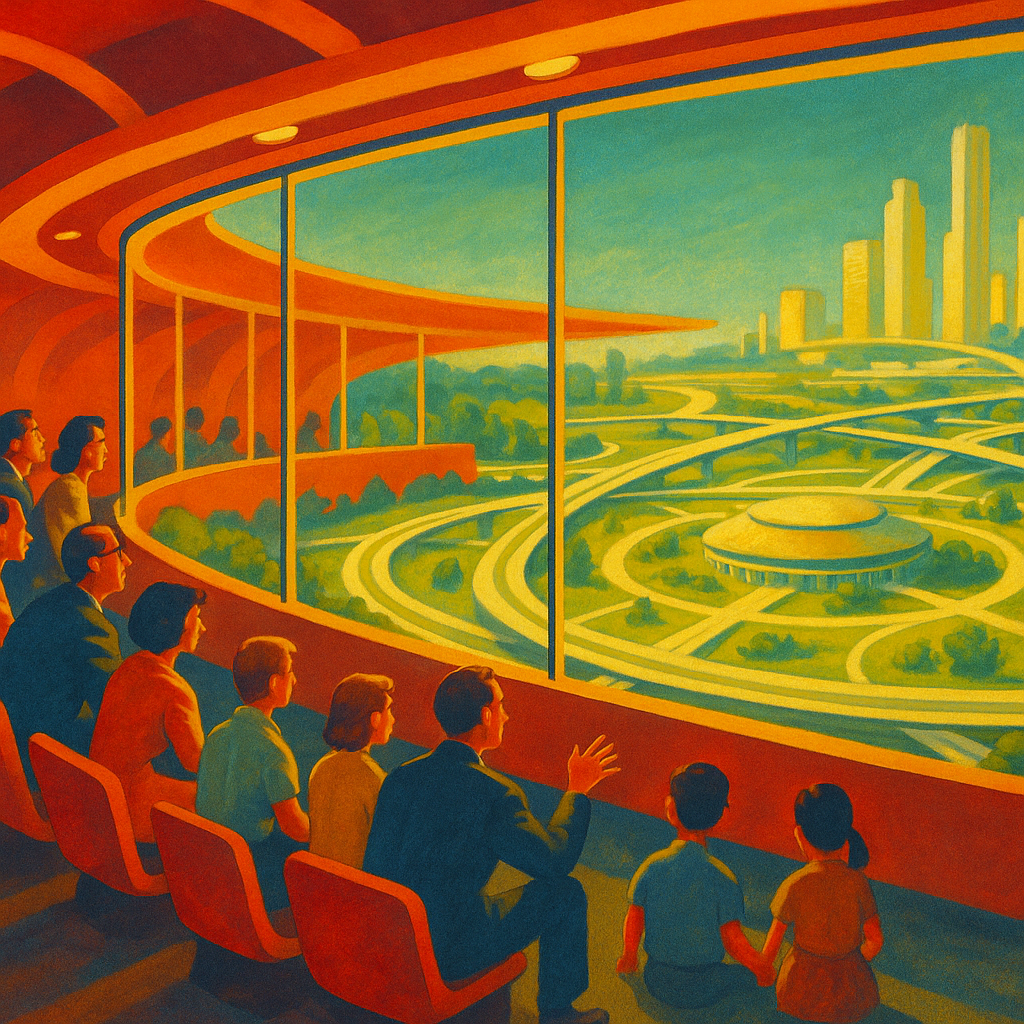
In 1939, one in three Americans visited the World’s Fair. They came to experience a future worth building. The Fair functioned as a perceptual rehearsal for a shared dream that later cohered into the American Century.
At Dunkirk, the situation was reversed. There was no dream, no plan, no institutional competence to rely on. And yet, the Little Ships came.
Ordinary citizens acted not because they had been persuaded, but because the situation had become perceptually undeniable. Courage emerged from clarity.
These examples are complements. The World’s Fair shows how perception mobilizes hope. Dunkirk shows how perception unlocks courage. Both demonstrate that when institutions falter, people act, if they can see what matters.
The Role of Brands Today
This is the context in which brands now operate.
Institutions underperform. Attention is saturated. People are not patiently waiting for better arguments. They are stunned into passivity by the absence of clarity.
Facilitating perception is therefore no longer optional. It is the work.
This work requires courage. It requires restraint. It requires a point of view strong enough to exclude what doesn't matter.
Brands that succeed will not be those that explain more clearly, but those that restore the conditions under which meaning can form at all. Stewardship will be the new sales.
Wisdom Already at Hand — and the Return Home
None of this requires new ideas. The wisdom is already in circulation.
McLuhan showed us how experience shapes behavior. Wenders reminded us that seeing is a moral act. Christensen clarified value. Kondo restored joy as signal. Joseph Campbell revealed the power of shared meaning. Steve Jobs composed and orchestrated with all of it, and proved it works.
The task now is integration.
The Circudyne Odyssey ends like Homer’s, and even more like Kubrick and Clarke’s: with a return home, but with rebirth.
Our planet is that home, and the Circular Century is the rebirth.
We can do it. We just need to see.
Enjoy the holidays! The Circudyne Letter returns with a new series in the new year. Between now and then, there will be a free summary of the Odyssey series. It has been a joy to get reenergized by the ideas we encountered on this trip.
🎁 Here is Marshall McLuhan's immortal cameo in Annie Hall:
If McLuhan was right that experience shapes behavior before understanding, then perception is where leadership begins. Below, for DYNAMO members: provocations that translate this insight into practical exercises for brands today.