
Carousel of Plenty
Something Borrowed
The performance economy comes home.

A framework pioneered by Clayton Christensen revealing that customers don't buy products — they hire them to do a job. Progress happens when we design around the outcome people seek, not the features we assume they want. Every circular economy intervention, every new system, must answer one question first: what job is actually being hired here?

Carousel of Plenty
The performance economy comes home.

The Neighbors
What happens when a block generates its own power, grows its own lunch, and tends its own things? The neighborhood becomes the operating layer of plenty.

Atelier
The neighborhood workshop where skilled artisans tend your things before they break — making them more yours over time.
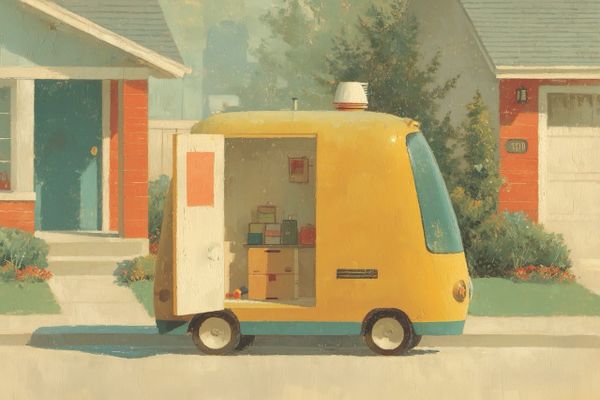
Robot Milkman
The Circular Century's symbol: an autonomous vehicle that delivers what you need and retrieves what you're done with. One stop. Both ways.

Diplomacy
Managing within a system in decline is a form of denial.

On the Bubble
Why do rigidly managed systems so often end in decay? A closer look at enshittification, linear logic, and why this moment calls for leadership.

Circudyne Odyssey
Closing out a season tracing a constellation of thinkers and ideas behind circular transformation — sharpening how we see perception, storytelling, and imagination, and preparing the ground for a harder question: what circularity must now deliver.

Self-Disruption
What practitioners miss about Christensen's self-disruption theory—and why it matters for scaling circular innovation

Jobs To Be Done (JTBD)
Clay Christensen showed us how to understand consumer preference beyond the A|B test. That key unlocks product-market fit for the Circular Century.

What Would Have To Be True (WWHTBT)
You cannot A|B test your way to system change. Why circular transformation requires asking 'What Would Have to Be True?' instead of 'How Might We?'