Closing the Mythology Gap

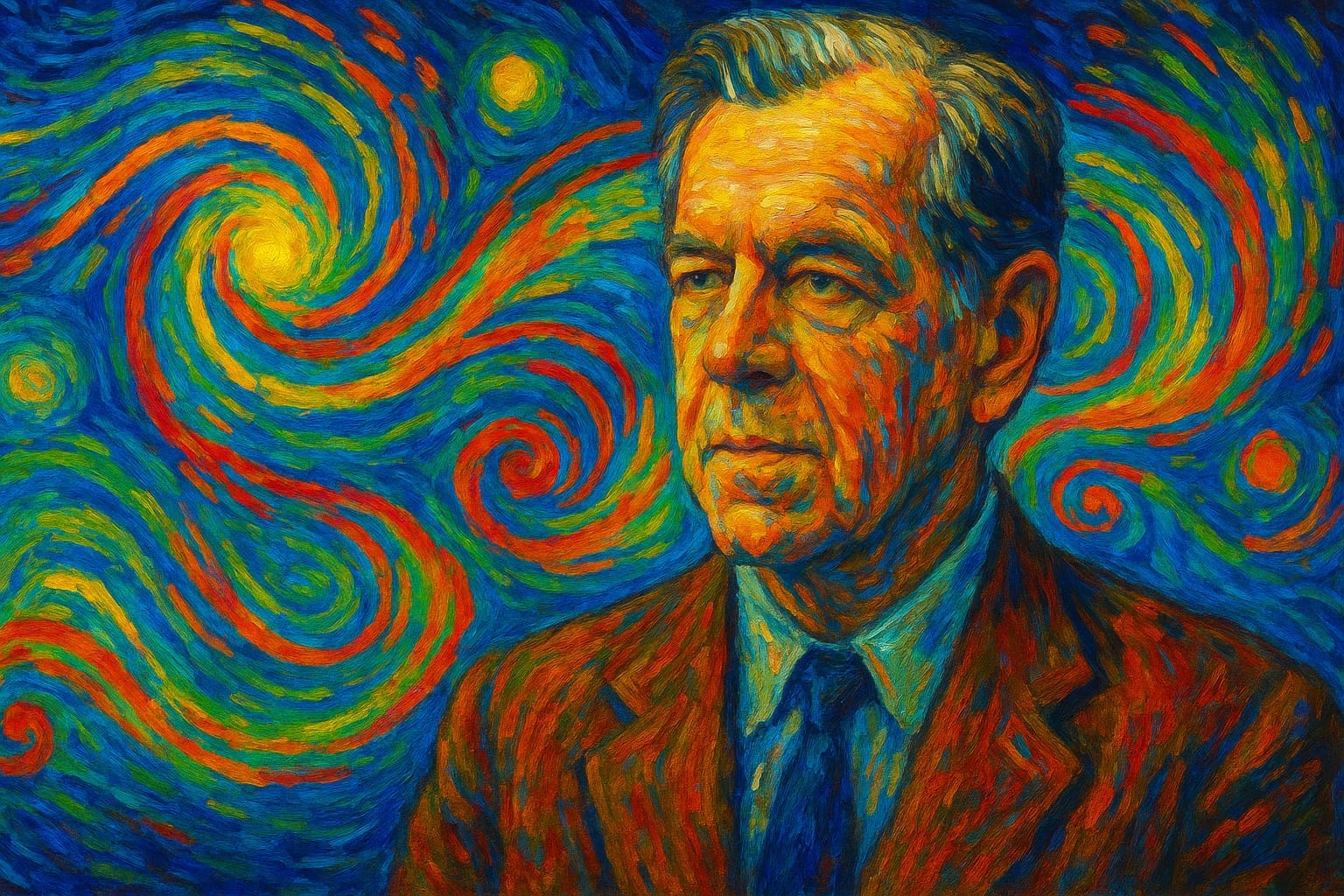
Last week’s Letter was about applying Dunkirk Spirit in today’s world. Now we cover the role mythology plays in cultural regeneration (and building iconic brands). For this we go to the source: Joseph Campbell, George Lucas and… Coca-Cola. We also refer to topics covered in The Overview Effect: An Objective Moral Context for the Circular Century.
- Closing the Mythology Gap
- The Moment George Lucas Realized He Was Making Things Worse
- Cosmology Shifts First — Then Mythology Must Follow
- What “Hilltop” and Star Wars Had in Common
- Campbell’s Cookbook: Recipes for Cultural Regeneration
- The Parallel Crisis: 1970s vs. 2020s
- Circudynamics: Operationalizing the Mythology
- Why This Moment Contains A New Hope
- Provocations
The Moment George Lucas Realized He Was Making Things Worse
In 1973, George Lucas understood something he could no longer ignore: he was contributing to the collapse of hope. He was working on Apocalypse Now while still carrying the bleak residue of THX 1138, and every headline reinforced the same cultural mood — Vietnam, Watergate, economic shocks, and a nation dissolving into cynicism. Hollywood’s new wave had perfected the language of disillusionment, and Lucas was one of its rising voices.
But one afternoon, staring at material that felt less like storytelling and more like emotional corrosion, he recognized the truth: he was amplifying the despair.
He later put it plainly: “All THX did was make people more pessimistic, more depressed, and less willing to get involved in trying to make the world better.” If he wanted to tell a story with a happy ending — one that healed rather than hollowed out — he would have to stop operating within the emotional logic of the moment.
He turned to Joseph Campbell, the authority on cultural mythology. His work provided Lucas with a cultural operating system that explained how cultures regenerate meaning when their existing myths fail.
— Joseph Campbell, Creative Mythology
Lucas realized that healing doesn’t come from information, persuasion, or critique. It comes from myth—specifically, myth that generates a shared emotional experience strong enough to pull a fragmented society back toward coherence.
Cosmology Shifts First — Then Mythology Must Follow
To understand what Lucas intuited, we have to rewind to December 24, 1968. Orbiting the Moon, astronaut Bill Anders looked out the window of Apollo 8 and saw Earth rising above a dead lunar horizon. He snapped the photograph now known as Earthrise, and it delivered a cosmological correction: Earth was no longer an infinite stage for human activity, but a finite, interconnected, vulnerable sphere suspended in blackness.
— Joseph Campbell, The Power of Myth
Campbell understood that when humanity’s cosmology changes—from geocentric to heliocentric, from divine right to democratic equality—our myths must update to match the new reality. When they don’t, cultures fracture.
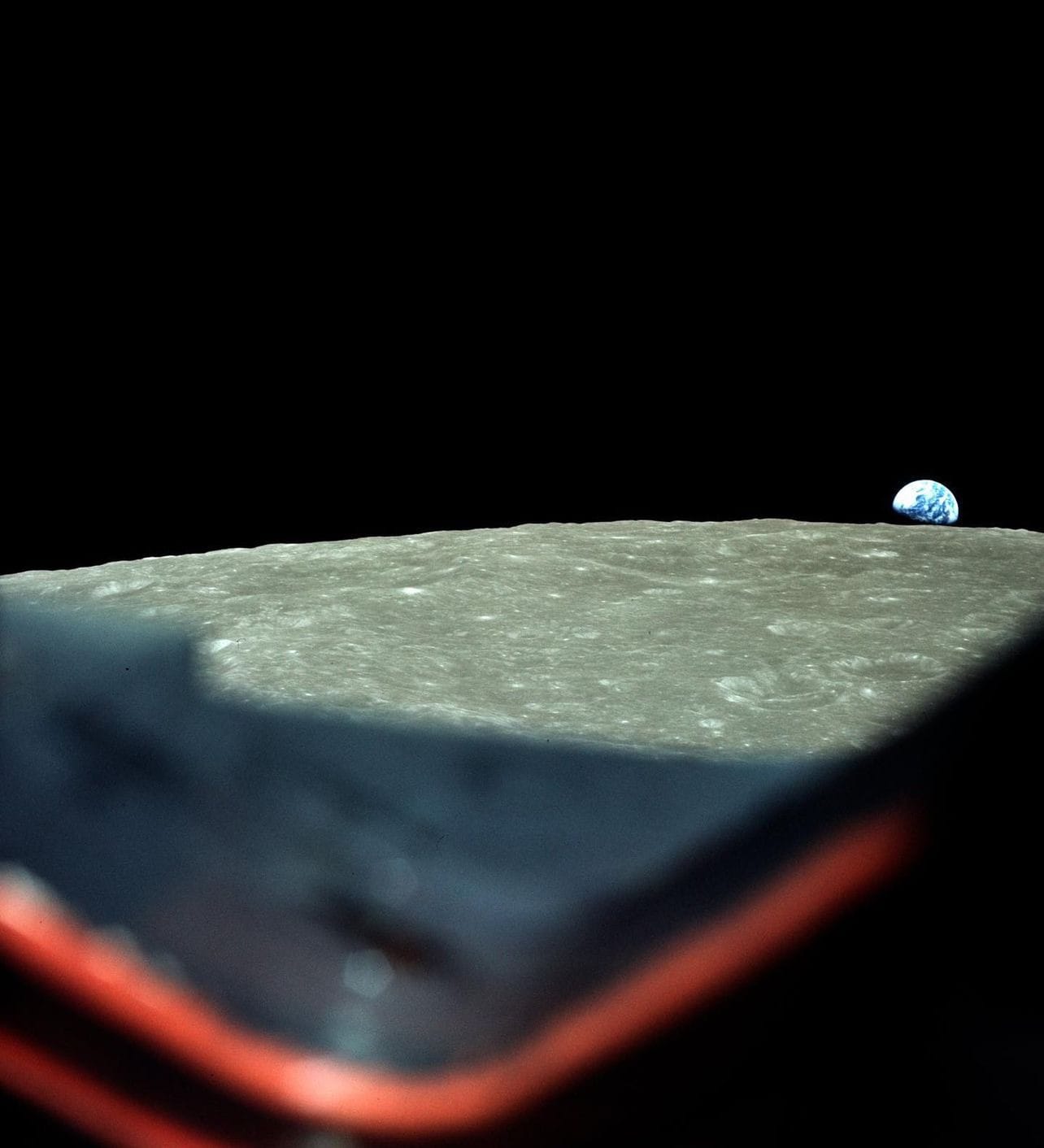
Earthrise was our Copernican moment. Yet the myths governing modern economics never updated. Boardrooms still operate on a pre-Earthrise cosmology:
| Pre-Earthrise Boardroom | The Earthrise Reality |
|---|---|
| Earth as infinite source and sink | Earth as finite & vulnerable |
| Humans as separate from nature | Humans interconnected |
| Growth as score | Growth as regeneration |
The result is the Mythology Gap: the dissonance between what we know about the world and the stories through which business organizes itself. Eco-anxiety rises. Polarization deepens. People crave meaning but are offered planned obsolescence instead.
This resembles the cultural wound Lucas saw in the 1970s — the same wound Coca-Cola attempted to heal, unexpectedly, with a 60-second ad.
— Joseph Campbell, The Power of Myth
What “Hilltop” and Star Wars Had in Common
In 1971, Coca-Cola aired “Hilltop,” a simple scene of young people from different cultures singing about harmony. There were no product features, no arguments, no claims. It was a snapshot of resolution. Hilltop didn’t describe a solution; it generated the feeling of the solution.
George Lucas had the same goal:
“I realized after THX that people don’t care how the country’s being ruined. All that movie did was to make people more pessimistic, more depressed, and less willing to get involved in trying to make the world better.... We’ve got to regenerate optimism."
To do this, he turned to mythology. As Cass Sunstein puts it:
“Joseph Campbell, Lucas’s Yoda, pointed to people’s need to ‘feel the rapture of being alive, that’s what it’s all finally about, and that’s what these clues help us to find within ourselves.’ Star Wars contains those clues.”
He applied Campbell’s narrative model — a monomyth, popularly known as the Hero’s Journey — as the structure that would reliably produce that sense of renewal. After four years of worldbuilding, he released Star Wars (later A New Hope) in 1977. The shared sense of relief and optimism among the millions who watched it that summer shifted the national mood.
Both Hilltop and Star Wars succeeded for the same reason: they activated Campbell’s mythic functions, organizing cosmology, values, identity, and possibility. They resolved despair rather than describing it. And for a moment, they let audiences feel themselves living inside a better world.
— Joseph Campbell, The Power of Myth
Campbell’s Cookbook: Recipes for Cultural Regeneration
Campbell discovered more than the Hero’s Journey. He uncovered a set of archetypal “recipes,” each designed to resolve a specific cultural wound by generating a specific emotional outcome.
— Joseph Campbell, The Power of Myth
A sampling of his recipes that apply to circular transformation:
| Recipe | Expression | Application |
|---|---|---|
| Regeneration | Death & Rebirth | For legacy firms shedding linear identity without shame. |
| Reconciliation | Separated Twins | For brands trapped in the profit vs. planet dichotomy (Hilltop uses this one). |
| Abundance | Cornucopia | For industries gripped by scarcity, showing circular flow as generous. |
| Homecoming | Odyssey | Reframing circularity as a return to right relationship. |
| Cosmological | Creation Myth | For companies building circular categories that didn’t previously exist. |
Lucas chose the Hero’s Journey because 1970s America needed heroic success achieved with friends. Circular transformation requires choosing the recipe that resolves the wound your industry actually carries.
— Joseph Campbell, The Power of Myth
Parallel Crises: 1970s vs. 2020s
We are living through a similar narrative structure of crisis. The stakes are the same, but the cosmology is bigger:
| The 1970s Wound | The 2020s Wound |
|---|---|
| Vietnam & Watergate | Climate Crisis & Institutional Distrust |
| Oil Shocks | Energy Transition Anxiety |
| Mythology Collapse | Mythology Gap |
In the 1970s, America needed a national mythology. Today, humanity needs a planetary one. It is within the reach of brands to provide one, just like Coca-Cola did.
The journey to the Circular Century is that mythology — if we tell it not as guilt or compliance but as regeneration and hope for a better life.
— Joseph Campbell, The Power of Myth
Circudynamics: Operationalizing the Mythology
Lucas proved Campbell's discovery could heal a culture. But modern brands need a system for implementation, not just inspiration.
Circudynamics provides such a system. Each of its domains mirrors one of Campbell’s mythological functions, giving leaders a practical architecture for regeneration.
| Domain | Mythic Function | The Operational Shift |
|---|---|---|
| Horizons | The Cosmological Function | Strategic alignment with Earthrise reality. Reverse-engineer the future (“What would have to be true?”) in a way that matches the cosmology of a finite planet. |
| Living Futures | The Mystical Function | Experiential worldbuilding. Circular abundance must be lived, not argued—prototypes, exhibitions, and “Overview Effect” moments. |
| Catalysts | The Technological Function | ”Imagination and a pile of junk.” Use today’s real technologies — AI optimization, material passports, IoT — as the believable substrate of tomorrow’s circular worlds. |
| Connection | The Sociological Function | Culture and momentum. Diagnose which mythological recipe your audience requires and build for that feeling. |
| Craft | The Architectural Function | Integration into identity. Every touchpoint, every cue, every detail reinforces the mythic coherence—protecting against fragility and greenwashing. |
Why This Moment Contains A New Hope
The crisis we face is real, but the despair surrounding it is not fixed. Fragmentation is not fate. It is simply what happens when myths fail to match reality.
The good news — visible in Star Wars, Hilltop, and the view from Apollo 8 — is that cultures can heal quickly when the right story appears at the right moment. Circularity provides the system that gives coherence to a post-Earthrise world.
Our work is to regenerate optimism rather than document decline. To give people the emotional experience of life beyond the wound.
Lucas did it with myth. Coca-Cola did it with a chorus. We can do it with circularity.
The destination is the same as it was in 1977: the shared feeling that the world can be made whole again. And that feeling — regeneration — is how the future begins.
— Joseph Campbell
If the next era belongs to organizations that become fit for purpose in a post-Mythology Gap world, then our task is transformation into the story our future requires.
Below the fold: catalytic questions designed to help you build for that world, not the one we’re leaving behind.
💬 Discuss this post: mention @christian@circudyne.com on Mastodon or your favorite fediverse app.
Subscribe to continue reading