
A Pattern Language
Christopher Alexander built a language for making places that serve human needs beautifully and economically. It doubles as a manual for choosing well where no data exists — the exact position circularity strategists occupy today.


 Christopher Alexander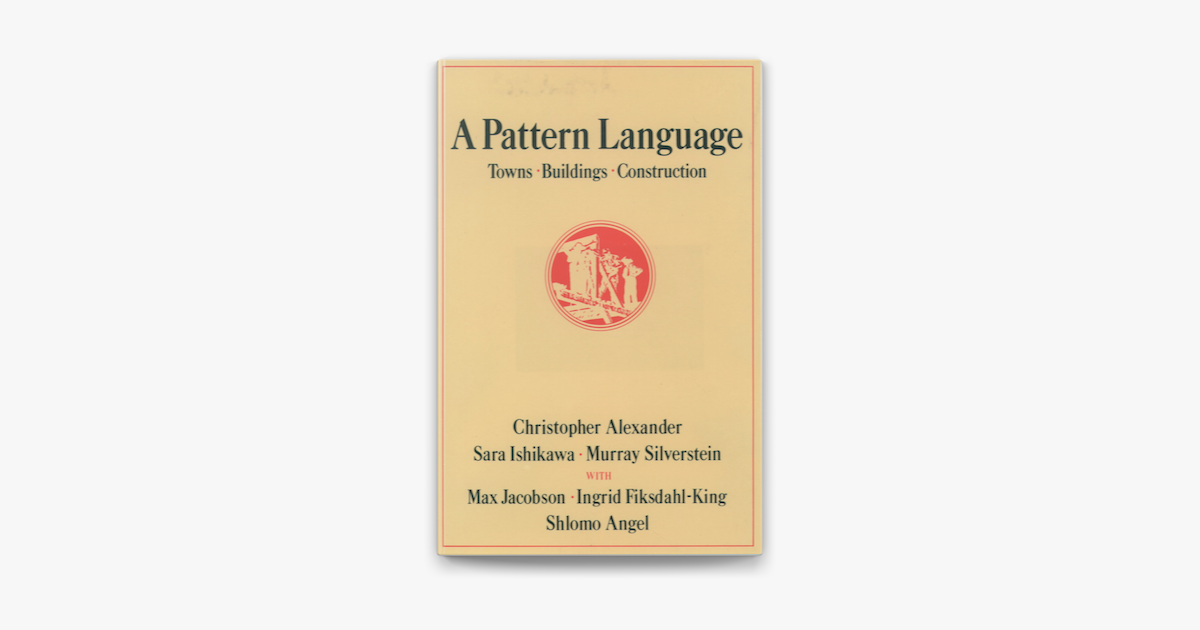
A logical consequence of living in a world where things are disposable is that the cost of ugliness goes down. If an object fails to please the eye or otherwise delight the senses, you can just wait to replace it. As objects become more durable — fixtures in our lives — that cost goes up. So good design matters in the Circular Century.
I’ve always been struck by Jony Ive's frequent use of the word "intention." He speaks often of designing with intent. I wanted to see where the language of intent comes from. So this week I read one of his influences, A Pattern Language by Christopher Alexander.
It provided an interesting counterpart to last week’s book: Toyota Production System by Taiichi Ohno. Ohno’s book is about building abundance in a context of scarcity by using systems. This one is too.
The book in brief
A Pattern Language was published in 1977 by Alexander and his colleagues at Berkeley. It is one half of a single work; The Timeless Way of Building is the theory, and A Pattern Language is the practice. The practice is 253 patterns, arranged from the scale of regions down to decor. Each pattern names a problem that recurs in our environment, then gives the core of its solution — stated, in the book's words, "in such a way that you can use this solution a million times over, without ever doing it the same way twice."
The patterns form a network. Each one is completed by the larger patterns above it and completes the smaller ones below it. Alexander draws the consequence in a sentence I marked as the essence of the book: when you build a thing, "you cannot merely build that thing in isolation, but must also repair the world around it, and within it, so that the larger world at that one place becomes more coherent, and more whole."
Two pieces of the machinery matter most for our purposes.
First, every pattern is offered as a hypothesis. Alexander marks each with asterisks that "represent our degree of faith." Two asterisks claim an “invariant” — a property of every well-formed solution to that problem, expected to endure for 500 years. One asterisk claims progress toward understanding. No asterisk is an open admission: we have not solved this one. And a rule of use follows: when in doubt about a pattern, leave it out.
Second, the language can be spoken as prose or as poetry. Compress many patterns into one dense place and you get "the most ordinary economy of space" — and, Alexander says, the only way to make "buildings which are poems." Economy and beauty are one act. Ohno would have understood.
A language I recognized
Regular readers know that we maintain a canon. One entry is Systemic Beauty: the design discipline that makes a circular system worth living with across decades. It has three elements. Compositional Logic — the parts compose in space. Instructional Design — the system teaches itself to its user. Timelessness — the parts compose in time, so old elements give continuity while new ones add capability.
I assembled that trio to apply to products in the context of circularity: products as services, products that last a long time, products built for loving maintenance. Reading Alexander, I found a counterpart, written half a century earlier, derived from buildings. Alexander’s rule Structure Follows Social Spaces (205) is compositional logic for place-making. The pattern format itself — problem, evidence, instruction — is instructional design; the book teaches the reader to build without gatekeepers. The two-asterisk invariants are the essence of timelessness.
I want to be careful about what this convergence means. Alexander did not anticipate our framework, and we did not borrow his. He wrote for place-makers. We write for object-makers. He could distill his patterns from 10,000 years of places that already work. Our exemplars do not exist yet, so we must reverse-engineer them from the future — asking, with Roger Martin, what would have to be true. Two pattern languages, built from different disciplines, with similar grammar.
Confidence pips
The asterisks deserve special attention, because they solve a problem afflicting strategists looking towards an uncertain future — which means pretty much all of us.
Martin borrows two of Aristotle's intellectual virtues: episteme, the systematic knowledge that can be taught and replicated, and phronesis, the practical wisdom required where precedent does not apply. The boundary dictates the approach. Before acting on any analysis, ask whether you are willing to assume the future will be identical to the past. If yes, follow the analysis. If no, do not use it.
Alexander's asterisks embody epistemic degrees of confidence. Two asterisks mark the places where the past is deep enough to trust — where the whole history of human dwelling offers proof of concept. The unstarred patterns hand the problem back to your judgment, and say, Go.
The modern enterprise has organized itself around the opposite habit. Data-centered decision-making carries a strong bias against decisions that require hard-to-acquire data. And there is no data from the future. So the future gets discounted. The longer horizon becomes less knowable, so the shorter one wins by default. Our built world shows the results: places built down to a budget rather than up to a purpose. Alexander offers the alternative: heuristics, expressed as such, ranked by declared faith, open to improvement by anyone. A system for industrializing the creation of beautiful work — and for justifying humanistic service at scale.
(He expresses confidence in terms of faith, which is kind of interesting. That’s given me something to think about.)
What the book means to me
Alexander built his language for towns facing economic ruin. Ohno built his system in a country recovering from obliteration. Circularity answers imperatives of its own. The revealed pattern: constraint is the parent of the beautiful outcome, not its enemy.
That is why the argument in favor of circularity should not be one of denial. Circularity decouples value creation from resource extraction by daring to imagine the alternative, and the abundance it creates is a clear-eyed embrace of a finite planet. The Earthrise photograph and Carl Sagan’s Pale Blue Dot soliloquy are celebrations, not lamentations, of finiteness. The beauty of our home, seen at any scale, is a function of its fragility. To make a durable, lovely home here — at once in defiance of that fragility and in harmony with it — is the fullest expression of consciousness I can conceive.
The point is not to survive, but to live. Not just as individuals; as a planet full of different forms of sentient beings. We should not sacrifice that potential to the exigencies of the workweek and the pull of the lowest common denominator. The resignation to take what comes is a disease. Books like A Pattern Language are part of the cure. Alexander wrote it, he says, "as a first step in the society-wide process by which people will gradually become conscious of their own pattern languages, and work to improve them." That is as fine a description of this letter's ambition as I could write myself.
The long lead time
The Towns patterns are where the book's critics wince. World government of independent regions. Farmland open to all. Scattered work. It is easy to file this under 1970s Berkeley and move on. I think that understanding is a mistake — and the mistake is instructive.
These patterns (to which Alexander assigned numbers, see below) did not fail on the merits. They failed on timing. The centralizing technologies of the twentieth century — steel and stamping, then chip fabrication — undermined Scattered Work (9). Big box retailers overtook Individually Owned Shops (87). Platform enshittification replaced Small Services Without Red Tape (81). The economics of the era ran against the grain of the patterns, and the incumbents those economics created have concentrated resources to prolong their moment.
But the pendulum has reached its apogee. The enabling technologies of the Circular Century — Distributed Power, Ambient Intelligence, Recombinant Matter — are decentralizers, just as the grid, the automobile, and mass production were centralizers a century ago. Read Alexander's Towns section again with that lens, and it stops being a utopian artifact. It becomes a catalog of what is about to become buildable. The forces of decentralization are arrayed in favor of order now; it is the incumbents who deal in chaos.
 Christian Rishel
Alexander says no pattern can live in isolation — and neither can this letter. The rest is for Dynamo members, the people building plenty with us. If you're reading as a guest, you're welcome here. But the best seats are reserved. Join the Dynamos.