The Robot Milkman
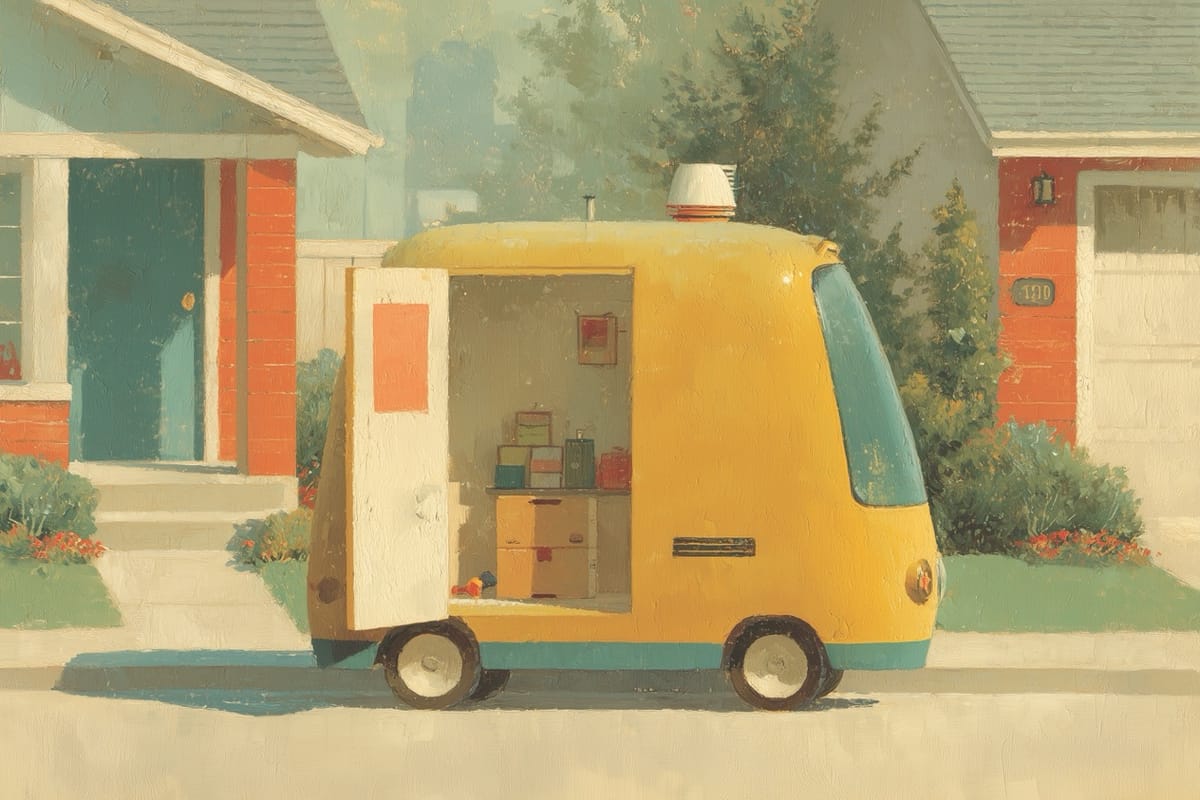
The Circular Century's symbol: an autonomous vehicle that delivers what you need and retrieves what you're done with. One stop. Both ways.

This is the first letter of the Carousel of Plenty, a series exploring products and services that could only exist in the Circular Century. We talk a lot about circularity transformation — why it matters, how it works, what it demands of leaders. This season, we show you where it leads. Each essay presents one solution: something you'd use, live with, or depend on in a world designed for permanence rather than disposal. The premise is simple. The linear economy promised progress and delivered volume — more things, fewer of them worth having. The Circular Century delivers plenty: the precise amount that satisfies without burdening. These are its furnishings.
Brings What You Need. Takes What You Don't.
Now, I know what you're thinking. Another gadget, another gizmo, another thing to keep track of. But folks — this one's different. This one takes things away.
See that little vehicle at the curb? Came by this morning, same time it always does. Dropped off new filters for the air purifier and the water pitcher — the old ones already boxed up on the porch, and off they went, back to the manufacturer. I didn't lift a finger. Didn't even have to remember. The system just... knows.
Last Saturday the kids wanted movie night in the backyard. So we ordered a projector — a beautiful thing, German optics, the kind of picture you'd swear was a theater screen. It showed up Friday afternoon. Sunday morning we set it back on the porch, and by Monday it was at somebody else's house, making somebody else's kids gasp at the size of the dinosaurs. We got the movie. They got the movie. Nobody got a five-thousand-dollar projector collecting dust on a shelf.
But here's the part that really gets Mother excited. You know that jar of cooking oil under the sink? The one you can't pour down the drain but can't bring yourself to throw away? She puts it in the return bin now. Out it goes, gets converted to biofuel, and that's that. Same with the dead batteries, the broken tire pump, three cables to something nobody owns anymore. She loaded the whole junk drawer into the bin last Thursday. By Friday, every bit of it was at a recovery facility. She's been smiling about that tidy drawer all week.
And the knives. Oh, the knives. You know, in the old days we just put up with dull knives. Same way our grandparents put up with bad coffee — figured that's just how it was. Now the kitchen knives go out in the return bin every few months. They come back sharp enough to make you wonder how you ever cooked with the ones you had before. The cobbler picks up the shoes the same way. It's the kind of care people used to reserve for their very best things. Now it's just... how things work.
Oh — and I almost forgot. Hear that chime? That's Aunt Gladys' lasagna. She never misses a Thursday. Her speciality — the one with the béchamel, you know the one — arrives in a reusable container, warm from her kitchen across town. Last week we sent back the dish with a jar of Mother's pickled beets. The vehicle handled the whole exchange. Gladys called that night to say they were the best beets she'd had in years. I didn't even know Mother made pickled beets.
One vehicle. One stop. Everything comes, everything goes. Nothing piles up in the garage, the closet, or the conscience.
This is life in the Circular Century, friends. And I've got to tell you — it's a great big beautiful tomorrow. We're already living in it.
For the Consumer
Everyone over forty remembers the milkman. He brought full bottles and took the empties. The glass went back to the dairy, got washed, got filled, went out again. Nobody called this sustainability. They called it regular life.
Everyone under forty has Amazon, and knows the routine. The parcel arrives. Into the recycling bin goes the box it came in — maybe. The packaging was engineered to survive the journey. Beyond that — left to happenstance. It served the seller. It burdens the buyer.
That asymmetry is the design signature of linear logistics. Delivery is a service. Disposal is an externality. Everything that happens after the package lands on your doorstep — the breakdown, the sorting, the guilt, the Saturday trip to the donation center — is labor the system transferred to you without asking.
The Robot Milkman reverses that transfer, and closes the loop. An autonomous vehicle that arrives at your door, drops off what you need, and picks up what you're done with. Filters going back for refurbishment. Cooking oil headed for biofuel conversion. A broken tire pump bound for material recovery. Knives out to the master sharpener, back in a week with an edge that changes how you cook. The retrieval function that the linear economy abandoned — restored, automated, and made invisible.
The job to be done runs deeper than delivery. Amazon solved "get stuff to your door." Waste management solved "get stuff away from your door," but the tell is in the name: it's still waste, and gets treated that way. The Robot Milkman solves both halves in a single stop: I want access to what I need without the burden of what I'm done with.
Go deeper still. What you want is for your relationship with things to be simple. No guilt about the packaging. No junk drawer of dead batteries and mystery cables. No expired product aging in the back of the cabinet. The system handles the lifecycle. You handle the living.
The doorstep as a bus
In computer science, a shared communication channel is called a bus. A bus is agnostic to what data passes through it, and connects everything to everything else. The Robot Milkman turns your doorstep into exactly this, but for stuff. One interface, open to the entire circular economy. Toner cartridges from a manufacturer in Shenzhen. A box of fresh produce from your local farmer. A German projector arriving Friday for movie night, departing Sunday for the next family who wants it. Compost going out, garden soil coming back. Aunt Gladys' Thursday lasagna in a reusable dish.
The doorstep doesn't care what's in the bin. It cares that things move, with efficiency and perfect information. And because the system is standardized — shared containers, shared routes, shared protocols — it works for everything and everyone, from multinational brands to the woman three blocks over who makes jam.
This composability is what separates the Robot Milkman from a delivery service with a return label. A delivery service connects you to one company. The Robot Milkman connects you to a system. One vehicle handles a dozen material flows in a single stop. It's the postal service reimagined for physical goods — and like the postal service, its power comes from universality. Anyone can send. Anyone can receive. The network carries it all.
Own what appreciates. Borrow what depreciates.
The circular economy unlocks value in a way that the linear economy is designed to undermine: some things gain value when you care for them. A cast-iron skillet. A well-made pair of boots. A set of kitchen knives that come back from the sharpener better than they left. These are worth owning — and the Robot Milkman makes owning them better, because the maintenance that keeps them appreciating is now a service the infrastructure provides. You don't have to find the cobbler, drive to the cobbler, remember to pick up the shoes. Proper maintenance is the default.
Other things lose value the moment you take them home. A projector. A carpet cleaner. A snowblower you'll use three times this winter. These are worth using — and then releasing back into the system so someone else can use them tomorrow. The Robot Milkman makes this so frictionless that the old instinct to buy and store starts to feel like hoarding. Why own a five-thousand-dollar projector that sits in a closet eleven months a year when a better one shows up on your porch the afternoon you need it?
The linear economy couldn't make this distinction because it had no return channel. Everything was a purchase. The Robot Milkman gives you the infrastructure to be strategic about what you keep and what you access — and makes both modes feel equally effortless.
Reach out and touch someone
This is how the Robot Milkman becomes something warmer than infrastructure. The early telephone system did more than just transmit information. It connected people. It turned distant relationships into daily ones. It made the aunt in another city feel like the neighbor next door.
The Robot Milkman does the same thing for the physical world. Aunt Gladys sends her lasagna on Thursday. You send back Mother's pickled beets. The CSA share arrives from the farm twenty miles out in crates that go back next week. A friend across town drops a novel into the system because she thinks you'll love it. The reusable containers circulate. The relationships deepen. The network carries béchamel and beets and borrowed books with the same quiet efficiency it carries toner cartridges and spent cooking oil.
The linear economy made distance cheap and connection disposable. The Robot Milkman makes connection cheap and distance irrelevant — for things, the way the telephone did for voice.
This is the difference between volume and plenty. Volume is more packages, more boxes, more waste, more trips to the curb. Plenty is the precise amount that satisfies: the right thing arriving when you need it, the finished thing departing when you don't, and your home staying clean, orderly, and stocked with only what deserves to be there. The word "enough" stops being a constraint and becomes a description of how the good life feels when the system works with you instead of against you.
The mid-century American dream included doorstep service as a standard feature of civilized life. Milk, bread, ice, laundry — services came to you, and the containers went back. As it evolved, the linear economy dismantled this in favor of self-service and called it freedom. The Robot Milkman restores what was taken — with better technology, broader scope, and a reach that extends from the manufacturer to the neighbor to the farm to the friend. Every solution in the Carousel of Plenty depends on a logistics layer that moves in both directions. This is that layer. It's why we start here.
By the Producer
This section uses Roger Martin's Strategy Choice Cascade — Winning Aspiration, Where to Play, How to Win, Must-Have Capabilities, Enabling Management Systems — followed by the "What Would Have to Be True" test that reveals why this solution can only exist in a circular economy.
From the producer's side, the Robot Milkman looks like a logistics company. It behaves like a utility. And it wins like a platform.
Winning Aspiration: Become the trusted last-mile interface for the circular economy. The infrastructure that makes all performance economy models viable. Not the company that delivers your groceries or your packages — the company that connects your household to the entire material system, in both directions, permanently.
Where to Play: Residential last-mile logistics, specifically the return and retrieval function that every existing carrier ignores. FedEx, UPS, and Amazon have spent decades optimizing one-way delivery. Their trucks leave the warehouse full and come back empty. The return trip is dead weight — a cost center with no corresponding revenue. The entire economics of linear logistics treats the journey home as waste.
This is the opening. The Robot Milkman plays in the space that one-way carriers structurally cannot, because filling the return trip would require them to redesign their cost model from the ground up.
How to Win: Bi-directional route density. Every delivery is also a pickup. The same vehicle, the same stop, the same relationship — but the vehicle is never empty in either direction. Rotable filters going back to the filter maker. Reclaimable electronics headed for material recovery. A neighbor's lasagna dish returning across town. Expendable cooking oil bound for biodiesel. A pair of boots headed to the cobbler. The cargo is diverse, but the route is unified. One stop services six material flows.
This density is a structural cost advantage over one-way logistics. The Robot Milkman doesn't compete with Amazon on delivery speed. It competes on system completeness — and the completeness compounds with every manufacturer, every neighbor, every local service provider that joins the network.
Must-Have Capabilities:
Material identification and sorting at point of pickup. The vehicle needs to know what it's collecting and where each item goes next. Every object in the return bin — a spent filter, a jar of cooking oil, a pair of boots — must be legible to the system at the moment of collection.
An intelligence that views every home the way a freight forwarder views an airport — not as a destination, but as a node in a living network. It operates like air traffic control, but at a scale that exceeds it by an order of magnitude: millions of vehicles instead of tens of thousands, billions of parcel movements instead of millions of passengers, millions of sorties every hour.
Partnerships guaranteeing return-stream demand. The system only works if somebody on the other end wants what comes back. Sometimes that's a manufacturer. Sometimes it's a biofuel company, a cobbler, or Aunt Gladys waiting for her dish.
Enabling Management Systems:
Digital material passports embedded in products and packaging, telling the vehicle what it's picking up and routing it to the right destination. The passport is the system's language — without it, the vehicle is guessing.
A customer-facing interface that makes returning as frictionless as receiving. No labels to print. No boxes to find. No carrier to schedule. The bin is the interface. The system does the rest.
A network protocol that lets multiple participants share the same retrieval infrastructure, the way multiple shippers share the same postal service. The doorstep becomes a universal bus. The protocol is what makes it universal.
What Would Have to Be True
One thing above all: somebody has to want it back.
Every touchpoint in the system requires an active send-receive transaction. Sometimes the receiver is a manufacturer — the filter maker who wants the spent cartridge for remanufacture. Sometimes it's the biofuel company that wants your used cooking oil. Sometimes it's the cobbler who'll resole the boots and return them next week. Sometimes it's Aunt Gladys, who wants her lasagna dish back so she can fill it again on Thursday.
In a planned obsolescence economy, that want doesn't exist at scale; only the landfill does. The product was designed to fail and be repurchased. Return infrastructure is a cost center with no upside. Nobody wants the old one back because nobody profits from having it. In that model, of course the Robot Milkman is economically irrational. There's nothing worth picking up, and no one willing to pay for the trip.
Only when the business model changes does the math change with it. When the manufacturer retains ownership — the performance economy, where you buy lumens and the company keeps the bulb — the product must come back, because it still belongs to the maker. When the manufacturer profits from material recovery — the circular value chain, where reclaimed inputs cost less than virgin ones — the product is worth getting back. When the neighbor profits from generosity and the cobbler profits from craft, the system carries those flows too. In every case, the return trip stops being a cost center and becomes a reason to exist. The vehicle that was irrational under planned obsolescence becomes indispensable under circularity.
It looks like a logistics company. It behaves like a circulatory system. Every pickup is a heartbeat.
The Robot Milkman is the part of that system we can see — the agent at the door, the vehicle at the curb — but beneath it runs a bi-directional infrastructure connecting manufacturers, craftspeople, neighbors, farms, and recovery facilities into a single living network. Every solution in the Carousel of Plenty depends on that network moving things in both directions. The Robot Milkman is how your household touches it. It can only exist in a circular economy. And a circular economy, at consumer scale, can only function with something like it at the last mile.
No single company runs the Robot Milkman alone. The system requires industry coordination at a level that, historically, only emerges when the economic incentive becomes overwhelming — or when someone builds the expo pavilion that makes everyone see — and want — it at once.
Image prompt:
A sleek friendly autonomous delivery vehicle in citrine yellow parked at a suburban front door at dawn, a homeowner seen from behind handing a neatly packed return container to the vehicle's open compartment, warm morning light, neighborhood visible in background with similar vehicles on other porches, mid-century advertising illustration style, 1960s World's Fair poster aesthetic, bold confident graphic design, flat color areas with clean edges, warm optimistic palette featuring citrine yellow and teal and coral red accents, Madison Avenue print advertisement quality, retro-futuristic consumer optimism, slightly stylized figures without detailed faces, cheerful domestic scene, gouache and screenprint texture
The rest of this letter is for Dynamo members — the people building plenty with us. If you're reading as a guest, you're welcome here. But the best seats on the Carousel are reserved. Join the Dynamos.