The Atelier
The neighborhood workshop where skilled artisans tend your things before they break — making them more yours over time.

This letter is part of the Carousel of Plenty, a series exploring products and services that could only exist in the Circular Century. We talk a lot about circular transformation — why it matters, how it works, what it demands of leaders. This season, we show you where it leads. Each essay presents one solution: something you'd use, live with, or depend on in a world designed for permanence rather than disposal. The premise is simple. The linear economy promised progress and delivered volume — more things, fewer of them worth having. The Circular Century delivers plenty: the precise amount that satisfies without burdening. These are its furnishings.
Your Things Deserve an Artist
You know, it used to be that when something wore out, you just went and bought another one. The jacket got a little tired in the shoulders. The upholstery on the car seat went thin where your elbow sits. The color faded on a phone case after a summer in the sun. And what could you do? You lived with it, or you replaced it. Those were your options.
Well, friends, let me tell you about the place down the street that changed all that.
It's called an atelier — that's a fancy word for a workshop, but the fancy is the point. This isn't a repair shop. Nothing's broken. It's a studio where people who are very, very good with their hands (and have the latest tools) tend the things you own before they ever need emergency attention. They oil your boots. They adjust the jacket so the shoulder finally sits right — the way it never quite did off the rack. They re-cover the car seat in a fabric that develops a patina that belongs to you and nobody else.
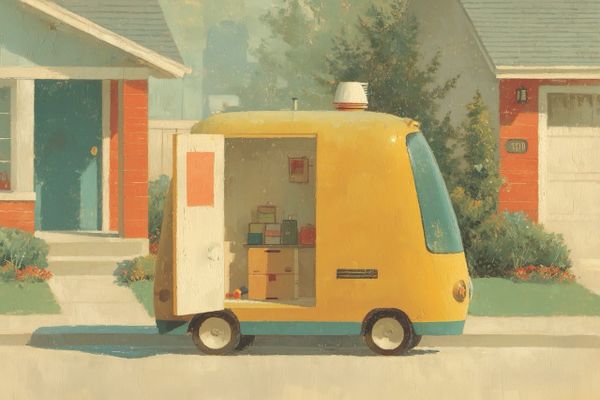
And here's the part Mother likes. That old set of kitchen chairs? The ones we were about to haul to the curb? She sent them in last Tuesday with the robot milkman. By Thursday they came back with new cane seats and a finish that made them look like something from a magazine. The kids didn't even recognize them. She's been polishing them every morning since, just for the pleasure of it.
Over time, your things stop getting worse. They get better. More yours. More suited. More beautiful. The artisan knows your name. Your history is on file. And the work — well, the work is art.
This is life in the Circular Century, friends. Your things deserve an artist. And now they've got one.
For the Consumer
Last week, we covered how the Robot Milkman works like a circulatory system. It is an infrastructure that hums beneath daily life, moving things in and out, silently, on schedule. The Atelier is where those things go when they need a human hand.
Not a repair shop. The distinction matters. A repair shop waits for failure. You bring it something broken and it restores what was. An atelier tends what's whole. It makes things fit better, last longer, look the way you always wished they had. The job is not restoration. It is evolution.
The word is borrowed from fine art. Hermès calls its workshops ateliers. A painter's studio is an atelier. The word carries weight: what happens here is skilled, considered, and beautiful. We use it deliberately. The person who re-covers your car seat is not a mechanic. She is an artisan. The word tells her so, and it tells you.
The atelier can be independent — a neighborhood studio where a craftsperson maintains everything from boots to bicycles to kitchen furniture. Or it can be part of a brand. Imagine an electronics manufacturer that doesn't just sell you a phone but runs a studio where your device gets fitted with the case material you chose, in the color you love, shaped to your grip. When the next generation of internals arrives, you don't replace the phone. You bring it in. The screen improves. The camera improves. The shell — the part that feels like yours — stays.
Or imagine an automaker whose showroom doubles as a refurbishment studio. BMW's Vision C concept already demonstrated the hardware: twist-key upholstery panels that detach completely, enabling seasonal refreshes without replacing the car. What's missing is the place — the beautiful, accessible place where customers experience the refresh as a visit to their craftsperson, not a trip to the dealer. The atelier is that missing piece.
Here is what all of this gives you that the linear economy never will.
Things that improve with age. Your boots get resoled with better materials. Your kitchen table gets refinished when the kids outgrow the phase where they carve their initials into everything. Your phone gets a new shell in a material that didn't exist when you bought it. Not repairs, but upgrades that honor the original.
A relationship, not a transaction. You go back to the same place. The same craftspeople. They know your jacket, and they know the left shoulder rides high because you carry a bag on that side. They adjust for it without being asked. It's couture, at scale.
Freedom from the replacement cycle. The linear economy needs you to discard. That is the business model: sell, obsolesce, sell again. The atelier breaks the cycle. When your things improve instead of decline, the pressure to replace evaporates. You stop shopping out of frustration and start choosing out of desire. That is sovereignty over your material life.
Think of a baseball player's glove. It arrives as a standard product. Through use and care — oiling, reshaping, relacing — it becomes his glove. No one else's hand fits it the same way. The atelier scales that experience to everything you own. Your car interior. Your winter coat. Your kitchen.
The deeper job is not "get my things fixed." It is: I want my things to become more mine over time.
And the economics that make this possible are not magic. They are structural. The robot milkman handles the logistics — pickup and delivery so you never have to drive anywhere. Ambient intelligence tells the artisan what needs attention before you call. Renewable energy powers the workshop for nearly nothing. Regenerative technologies abound. The only scarce input left is the artisan's skill, but skill is a capital investment with durable returns. Hermès proved this. When demand for their bags exceeded the supply of artisans capable of making the difficult saddle stitch, they did not automate or cut corners. They invested in creating new skilled artisans — elaborate training, purpose-built studios, conditions for lifetime employment. Their output grew even as quality and desirability held.
We have called this the atelier of democracy: the place where the Circular Century's promise of mass customization becomes real. What if the Hermès logic applied to everything — not at Hermès prices, but at prices made possible when the support system around the artisan approaches zero marginal cost?
By the Producer
The atelier only works when the manufacturer wants the product to last.
Under planned obsolescence, every year an artisan extends a product's life is a year of lost replacement revenue. The skilled maintainer is an economic threat. The manufacturer has no reason to share design intent, supply parts, or build for serviceability. In that world, the atelier is an adversary.
The Circular Century inverts this. When the manufacturer retains ownership, profits from remanufacture, or competes on stewardship reputation, the atelier becomes a partner, or a capacity. But in any case it is the place where consumer, producer, and product meet to make things better. Because the longer your things last, the more profitable the relationship.
Winning Aspiration: Become the trusted steward of products across their full lifetime — the relationship layer between manufacturer and owner.
Where to Play: The territory linear manufacturers abandon after the warranty expires. Post-purchase product lifecycle. The decades between sale and disposal where no one currently competes, because no one currently profits from being there.
How to Win: Skill. Knowledge of your specific products, your preferences, your history. Switching costs built on accumulated relationship — not contractual lock-in, but the fact that the artisan down the street knows your things and you trust her judgment.
What Would Have to Be True: Manufacturers must want products to last. They must share design intent, not just parts lists. The return network — that robot milkman — must exist to handle logistics. Energy must be cheap enough that skilled human attention is the dominant cost. And the culture must value craft again — must see the person who tends your boots as an artist, not a laborer.
Care is the new luxury. Unlike the old luxuries, it scales.
Image prompt:
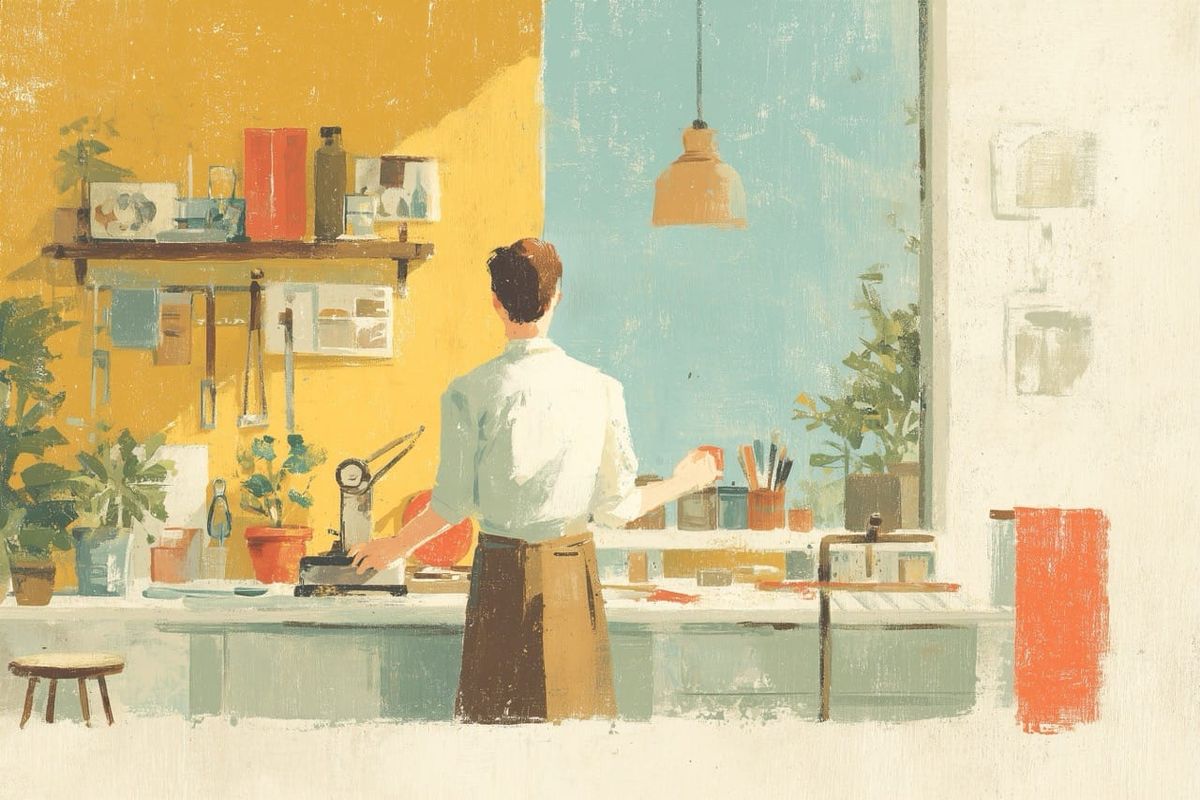
A craftsperson seen from behind at a well-lit workbench in a warm neighborhood atelier studio, carefully tending a beautiful woven textile object, artisan tools arrayed with care on the wall, warm citrine light streaming through a window, mid-century advertising illustration style, 1960s World's Fair poster aesthetic, bold confident graphic design, flat color areas with clean edges, warm optimistic palette featuring citrine yellow and teal and coral red accents, Madison Avenue print advertisement quality, retro-futuristic consumer optimism, slightly stylized figures without detailed faces, cheerful workshop scene, gouache and screenprint texture --ar 3:2 --s 300 --no photorealistic, photograph, HDR, dark, dystopian, gritty, lens flare, stock photo
The rest of this letter is for Dynamo members — the people building plenty with us. If you're reading as a guest, you're welcome here. But the best seats on the Carousel are reserved. Join the Dynamos.